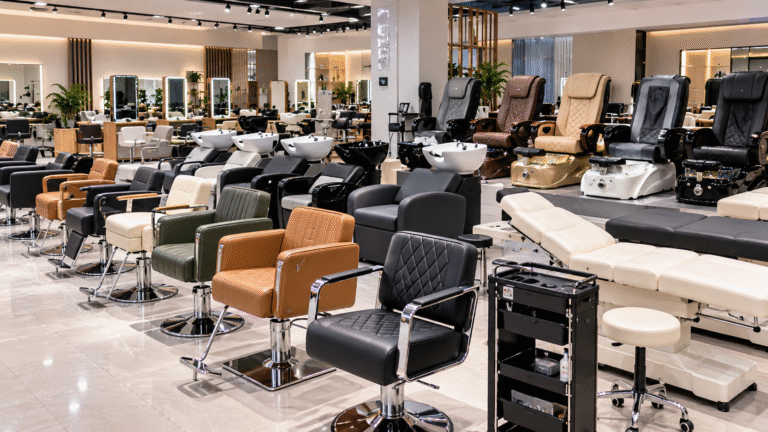
For a salon furniture distributor, that variety can be useful.
But it can also create a problem: more SKUs do not automatically create a stronger product range.
Once a distributor imports, stocks and supports salon furniture locally, every additional model creates work beyond simply adding another page to the catalogue.
The real question is not “How many models can we offer?”
It is “How many models deserve a place in our range?”
Why Can Too Many Salon Furniture SKUs Become a Problem?
For a distributor, a salon furniture SKU is not just a product image and a price.
Depending on the business model, it may also require inventory space, product photography, showroom space, sales knowledge, spare parts, after-sales support and future repeat-order management.
If several models serve almost the same customer at almost the same price point, the extra choice may add complexity without adding much commercial value.
This becomes particularly important for bulky products such as salon chairs, shampoo units, pedicure chairs and beauty beds. Unlike small beauty accessories, furniture takes up meaningful warehouse and container space.
Slow-moving variations can therefore tie up both space and working capital.
What Is SKU Rationalisation in Salon Furniture?
SKU rationalisation means reviewing a product range and deciding which models deserve to remain core products, which should be sold selectively, and which may no longer justify the inventory and operational complexity they create.
For salon furniture distributors, the objective is not necessarily to offer fewer products.
The objective is to make sure different products have different jobs.
A well-structured range might include:
- core models intended for regular stock and repeat sales;
- upgraded models for customers willing to spend more;
- premium or design-led products for higher-end projects;
- showroom or made-to-order products that do not require deep inventory;
- selected new products used to test emerging demand.
This creates a much clearer range than simply importing many visually similar models.
1. Similar Products Can Compete with Each Other
Suppose a distributor carries eight styling chairs at almost the same retail price.
If the differences are mainly stitching, armrest shape or small decorative details, those eight chairs may not actually serve eight different market needs.
Instead, they may divide demand that could otherwise be concentrated around two or three stronger models.
The same problem can happen with shampoo units, pedicure chairs and beauty beds.
China’s salon furniture supply base offers extensive design variation and customisation. That flexibility is valuable, but distributors still need to decide which differences matter to their own customers.
A factory’s ability to produce 100 models does not mean a distributor needs 100 models.
2. Every Additional SKU Uses Inventory Capital
Salon furniture is a relatively space-intensive product category.
A container filled with six variations of a slow-moving chair is commercially different from a container concentrated around proven core models.
The issue becomes even more important when colour is included.
One chair offered in black, beige, grey and several customised colours can quickly become multiple inventory combinations.
That does not mean distributors should avoid colour or design choice. It means there is a difference between offering a configuration and holding every configuration in stock.
Some products may justify local inventory. Others may work better as showroom samples, pre-order items or project-based configurations.
3. More Models Can Mean More Spare-Parts Complexity
This is one of the less visible consequences of expanding a salon furniture range.
Different models may use different pumps, motors, controllers, switches, plumbing components, basins, hinges, fittings or other replaceable parts.
As the installed product base grows, after-sales support can become more complicated.
A distributor may eventually need to answer questions such as:
- Which component belongs to which model?
- Is the current replacement part compatible with an older production batch?
- Can the same component be used across several models?
- Will this part still be available when customers need service later?
For a mature wholesale business, product selection therefore affects the after-sales system as well as the initial sale.
4. Repeat-Order Consistency Becomes More Important as Sales Grow
A new design can be exciting when it first appears in a supplier catalogue.
But once a distributor has photographed it, displayed it, promoted it and sold it into the local market, continuity becomes more valuable.
If a model becomes successful, the distributor may want to reorder it repeatedly.
That means the China supply side needs to support reasonable consistency in areas such as:
- dimensions and structure;
- upholstery appearance;
- colour and finish;
- key components;
- packaging;
- replacement parts.
This is one reason a smaller group of proven products can sometimes become more valuable than a constantly changing catalogue.
5. A Large Catalogue and a Large Inventory Are Not the Same Thing
This distinction is important.
A distributor can still present customers with a broad product range without stocking every product locally.
For example, a business might maintain:
- Core stock: proven models with regular local demand;
- Showroom range: selected products customers can see and test;
- Pre-order range: larger, premium or less frequently purchased products;
- Project range: customised products ordered against confirmed commercial projects.
This allows the catalogue to remain commercially interesting without treating every SKU as an inventory commitment.
How Should a Salon Furniture Distributor Structure Its Product Range?
There is no universal number of SKUs that is right for every distributor.
A distributor serving independent salons in one city has different requirements from a national beauty-equipment wholesaler, a multi-location chain supplier or a company serving large salon projects.
However, a useful starting principle is to give every product a clear role.
For each model, ask:
- Which customer segment is this for?
- Which price position does it occupy?
- What makes it meaningfully different from the model next to it?
- Does it need to be stocked, or can it be ordered when required?
- Is it likely to generate repeat orders?
- Can replacement parts and after-sales support be managed efficiently?
If two products have almost identical answers, there may be little commercial reason to carry both as core SKUs.
Core, Upgrade and Premium: A Simpler Way to Think About the Range
One practical way to organise a salon furniture range is around clear commercial positions rather than dozens of minor design differences.
Core Range
These are dependable products intended to handle a meaningful share of regular sales.
For a salon furniture distributor, this might include selected styling chairs, shampoo units, stools or other products with broad commercial appeal.
Upgrade Range
These products should give the buyer a visible or functional reason to spend more — not simply a different model number.
The difference might come from design, materials, functions, comfort, finish or configuration.
Premium or Project Range
These products may target premium salons, spas, chains or larger commercial projects.
They may not need to sit in deep inventory. A showroom sample combined with made-to-order supply can sometimes make more commercial sense.
This approach can also be applied within individual categories.
For example, we previously discussed how distributors can structure different price positions within a pedicure chair product range.
What Should Distributors Ask a China Salon Furniture Supplier?
When evaluating a salon furniture supplier in China, the conversation does not have to begin with “Send me your full catalogue.”
For an established distributor, more useful questions may include:
- Which models have stable repeat production?
- Which models share common components?
- Which products can be mixed efficiently in an order?
- Which colours and configurations are standard?
- Which products are better suited to custom projects?
- How are replacement parts handled?
- What can realistically remain consistent across repeat orders?
These questions help move the discussion away from catalogue size and toward long-term commercial usability.
Should Salon Furniture Distributors Offer Fewer Products?
Not necessarily.
The better objective is to offer enough choice without turning every possible variation into a stocked SKU.
A broad catalogue can help a distributor serve different customer segments. But inventory, showroom samples, made-to-order products and project products do not all need to be managed in the same way.
For many distributors, the stronger strategy is therefore not simply “fewer SKUs.”
It is fewer overlapping SKUs, clearer product positions and more deliberate inventory decisions.
From a China Supply Perspective
One advantage of sourcing salon furniture from China is the depth of available product choice.
Salon chairs, barber chairs, shampoo units, head spa beds, pedicure chairs, beauty beds, trolleys and related furniture can be sourced across different designs and price positions.
But the supply side should support the distributor’s range strategy — not dictate it.
A distributor does not need every model a factory can make.
What matters more is building a product range that fits the local market, can be reordered reliably and remains manageable as the business grows.
Building or Expanding Your Salon Furniture Range?
Explore salon chairs, shampoo units, head spa beds, pedicure chairs, beauty beds and other salon furniture for wholesale and distribution.
Explore Our Salon Furniture Range
info@lohaschinasourcing.com