A new development in U.S.–China trade could matter to importers sourcing consumer products from China.
The United States and China have released recommended product lists covering approximately US$30 billion of non-sensitive goods in each direction for more favorable tariff treatment under the newly established U.S.–China Board of Trade.
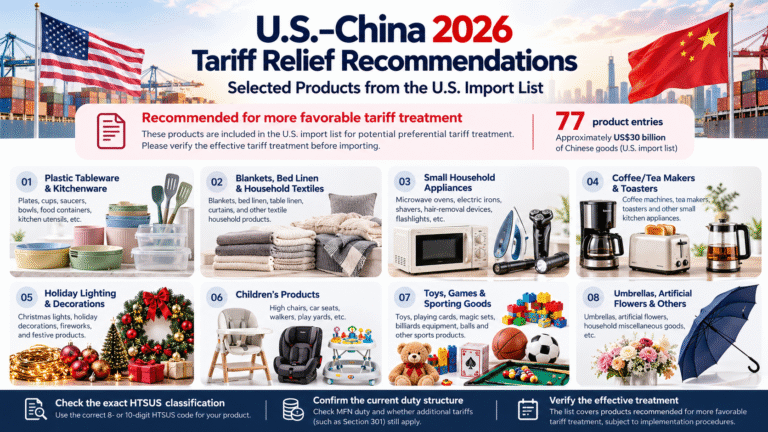
For U.S. imports from China, the published list contains 77 product entries, covering categories including household goods, small appliances, toys, holiday products and other consumer goods.
But there is an important distinction:
This does not mean that every product on the list has already automatically returned to the normal MFN tariff rate.
The current announcement concerns products recommended for more favorable tariff treatment. Importers should therefore verify the applicable HTSUS classification and effective tariff treatment before calculating landed cost or placing an order.
What Has the U.S. and China Actually Announced?
Under the U.S.–China Board of Trade, the two countries reached consensus on recommendations covering approximately US$30 billion of non-sensitive goods in each direction.
According to the White House, products on the U.S. export side include agricultural goods, fish and seafood, logs and wood products, cosmetics and medical devices.
Products imported by the United States from China include consumer goods such as small appliances, toys, holiday decorations and children’s car seats.
Subsequent product lists provide the specific tariff classifications under consideration.
How Many Chinese Product Categories Are Included?
The U.S. import list contains 77 entries.
The products cover a surprisingly broad selection of everyday consumer goods rather than strategic industrial products.
Examples include:
- fireworks;
- plastic tableware and kitchenware;
- electric and non-electric blankets;
- bed linen and table linen;
- curtains and other household textile products;
- umbrellas;
- artificial flowers;
- selected household appliances;
- electric shavers and hair-removal appliances;
- microwave ovens;
- coffee and tea makers;
- toasters;
- holiday lighting and decorations;
- children’s high chairs and car seats;
- sleeping bags and pillows;
- selected toys, games and sporting goods.
The exact treatment depends on the applicable HTSUS code, not simply the general product description.
Does This Mean the Additional China Tariff Has Already Been Removed?
Not necessarily.
This is one of the most important details for importers to understand.
The official U.S. language describes these products as being recommended for “more favorable tariff treatment”.
Earlier USTR documentation establishing the Board of Trade also explained that the mechanism would consider modifications to certain non-MFN tariffs while remaining subject to U.S. law and applicable implementation procedures.
Therefore, importers should not assume that a product shown on the list can immediately enter the United States at the standard MFN rate.
Before confirming a purchase, check:
- the exact 8- or 10-digit HTSUS classification;
- the current MFN duty;
- whether Section 301 or another additional duty currently applies;
- whether the announced preferential treatment has become effective;
- the effective date and any applicable conditions.
Why Does This Matter to U.S. Importers?
For many importers, tariffs have become part of the product-selection decision rather than simply a customs issue.
A significant additional tariff can change the landed-cost calculation enough to make an otherwise attractive Chinese product commercially difficult.
If preferential treatment is implemented for products on the new list, some categories may become more competitive again for U.S. buyers.
This can affect:
- landed cost;
- supplier comparison;
- retail and wholesale margins;
- China versus alternative-country sourcing decisions;
- the viability of restarting previously paused product lines.
For experienced importers, this is therefore not simply a tariff story.
It can change the sourcing economics of an entire product category.
Should Buyers Immediately Switch Their Sourcing Back to China?
A tariff change alone is not enough reason to change a supply chain.
Importers should compare the complete landed-cost and supply structure.
A lower tariff may improve the economics of sourcing from China, but buyers still need to consider product cost, quality consistency, tooling, packaging, logistics, supplier capability, lead time and switching costs.
For products where China already has a mature manufacturing base, however, lower additional tariffs could materially change the comparison.
What Should Importers Do Now?
The first step is surprisingly simple:
Check whether the products you already import — or products you previously considered sourcing from China — appear on the new list.
Do this using the HTSUS code rather than relying only on a product name.
For example, two products that consumers consider almost identical can sometimes fall under different tariff classifications depending on material, construction, function or other characteristics.
That classification difference can affect the final duty treatment.
A China-Side Sourcing Perspective
For buyers sourcing from China, tariff changes are most useful when they lead to a practical commercial question:
Does this product make economic sense to source from China again?
If a product category receives more favorable tariff treatment, buyers may want to revisit suppliers, quotations or product lines that previously became unattractive because of additional duties.
But tariff savings should be considered together with the full sourcing structure.
The cheapest factory quotation is not necessarily the lowest landed-cost solution, just as the lowest tariff does not automatically make a supplier competitive.
The objective is to evaluate the complete commercial picture.
Want the Product List?
We have整理ed the newly released product information for reference.
If you would like the PDF version of the U.S. tariff-relief product list, email us and we can send you a copy.
Need the 2026 U.S.–China Tariff Product List?
Request the PDF product list, or contact us if you are reviewing a China sourcing opportunity affected by the new tariff recommendations.
Or email us directly:
info@lohaschinasourcing.com