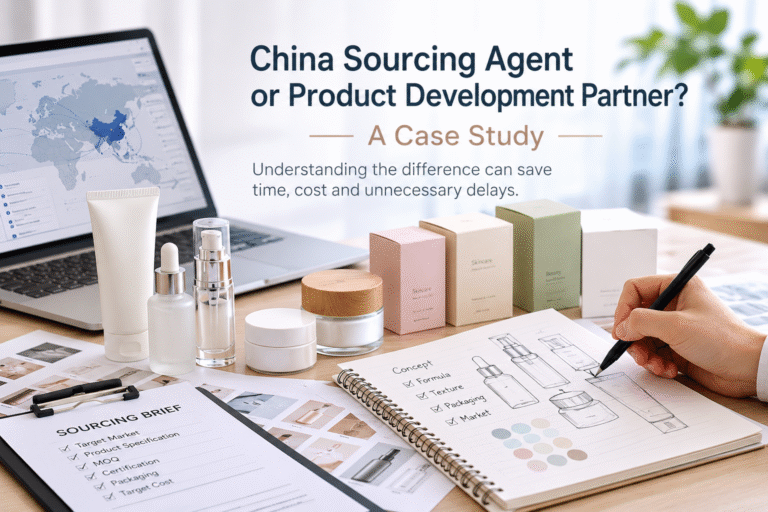
Are You Looking for a China Sourcing Agent or a Product Development Partner?
When businesses look for manufacturing partners in China, the word “sourcing” is often used to describe a wide range of activities.
In practice, however, supplier sourcing and product development are not the same service.
Supplier sourcing normally begins with a defined product requirement. Product development may begin much earlier, when the business is still exploring what to sell, how the product should look and which specifications are commercially realistic.
This anonymous case study illustrates why defining the project scope at the beginning can improve supplier selection, quotation accuracy and overall sourcing efficiency.
Case Background
A recent client, referred to here as Client A, was preparing to develop two new beauty brands.
At first glance, the assignment appeared to be a standard China supplier sourcing project.
After reviewing the project brief, it became clear that the client required support across several different stages:
- Product concept exploration.
- Product selection.
- Formula discovery.
- Packaging exploration.
- Supplier sourcing.
These stages are closely connected, but they involve different workflows, research methods and deliverables.
The case therefore became a useful example of how a project can move beyond conventional supplier sourcing into broader product development support.
The Initial Project Brief
The project involved two proposed beauty brands with different product-development needs.
Brand One: Children’s Skincare Concepts
For the first brand, the initial brief included ideas such as:
- Exploring innovative skincare formulas for children.
- Identifying fun textures suitable for social-media content.
- Researching distinctive packaging concepts.
- Finding suitable Chinese manufacturers.
The brief provided a creative direction, but several commercial and technical parameters still needed to be defined before factories could be evaluated effectively.
Brand Two: White-Label Beauty Product Range
For the second brand, the client wanted to explore the Chinese market for approximately 30 white-label skincare and beauty products that could potentially form a future product range.
This required more than identifying factories.
It also involved reviewing available product categories, assessing whether products suited the intended brand positioning and narrowing a large market into a commercially manageable shortlist.
Why the Project Required Further Clarification
Before contacting manufacturers, several practical questions needed to be clarified.
These included:
- What was the target MOQ?
- What was the target factory cost?
- What product size or fill volume should suppliers quote?
- Which certifications were mandatory?
- Which certifications were preferred but not essential?
- Should suppliers quote existing formulas or customized formulations?
- Which packaging features were required?
- Which packaging features were still open for exploration?
These are not minor administrative details.
They determine:
- Which factories are suitable.
- Whether the factories can accept the expected order volume.
- Whether the requested cost target is realistic.
- Whether suppliers can provide comparable quotations.
- Whether customized development is commercially practical.
Factories Quote Specifications, Not General Ideas
Creative ideas are valuable during the early stages of product development.
However, manufacturers need defined commercial and technical information before they can provide accurate quotations or assess production feasibility.
A factory will normally ask questions such as:
- What is the expected order quantity?
- What is the required product size?
- Is an existing formula acceptable?
- Is a customized formula required?
- What packaging format is preferred?
- What is the target market?
- Which certifications or test reports are required?
Without these parameters, suppliers can only make assumptions.
This may lead to:
- Quotations based on different specifications.
- Suppliers that do not match the project requirements.
- Unnecessary sampling.
- Repeated clarification.
- Longer development timelines.
The issue is not that factories are unwilling to quote.
The issue is that a meaningful quotation requires a sufficiently clear product brief.
Where Supplier Sourcing Normally Begins
Supplier sourcing usually begins after the buyer has defined the main product requirements.
A China sourcing partner may then help with:
- Identifying suitable manufacturers.
- Comparing quotations.
- Reviewing supplier capabilities.
- Coordinating samples.
- Clarifying specifications.
- Supporting negotiation.
- Following production.
- Coordinating quality inspection.
These activities require a sourcing brief that gives suppliers enough information to respond accurately.
A useful sourcing brief does not need to resolve every minor detail, but it should define the basic commercial framework.
When a Project Becomes Product Development
A project moves beyond supplier sourcing when the buyer still needs help deciding:
- Which products should be included in the range.
- Which product concepts are commercially suitable.
- Which formulas or textures should be explored.
- Which packaging direction supports the brand.
- How products should be positioned.
- Which features are essential.
- Which target cost is realistic.
At this stage, the work may involve:
- Market exploration.
- Product research.
- Trend review.
- Concept comparison.
- Formula exploration.
- Packaging exploration.
- Commercial feasibility assessment.
These activities are valuable, but they are broader than conventional supplier sourcing.
They may require a separate project phase, different deliverables and a different pricing structure.
Supplier Sourcing and Product Development Can Work Together
Supplier sourcing and product development are not competing services.
They often form different stages of the same project.
A practical sequence may look like this:
- Define the brand and product direction.
- Develop an initial product shortlist.
- Confirm target specifications and commercial parameters.
- Identify suitable suppliers.
- Compare quotations and capabilities.
- Arrange samples and refine the product.
- Confirm production requirements.
- Proceed to production and quality control.
The important point is to identify which stage the business has already completed and which stage still requires support.
Why Clear Scope Definition Matters
Many sourcing misunderstandings are not caused by unsuitable factories or difficult working relationships.
They occur because different parties use the word “sourcing” to describe different expectations.
For one business, sourcing may mean:
“We already know the exact product and need help finding the right manufacturer.”
For another, it may mean:
“We have a general brand idea and need help deciding what products to develop.”
Both are legitimate requirements, but they involve different scopes of work.
Defining the scope early helps both sides agree on:
- The project objectives.
- The required research.
- The expected deliverables.
- The project timeline.
- The pricing structure.
- The point at which supplier outreach should begin.
What Client A’s Case Demonstrated
Client A’s project showed that a request described initially as supplier sourcing may contain several earlier-stage product-development needs.
The project required both creative exploration and practical sourcing preparation.
Before suitable factories could be approached efficiently, the product concepts needed to be translated into clearer commercial requirements.
This did not mean that the original ideas were unsuitable.
It meant that the project needed to be structured in stages.
A phased approach could allow the client to:
- Review product opportunities first.
- Narrow the proposed product range.
- Confirm priorities and target costs.
- Prepare clearer product briefs.
- Approach suppliers with more specific requirements.
This would reduce unnecessary supplier communication and improve the quality of the resulting quotations.
Before Contacting a China Sourcing Agent
Businesses can make the sourcing process more efficient by preparing a brief that answers several basic questions.
Product Requirements
- What products are required?
- Are reference images or samples available?
- Which specifications are already confirmed?
- Which areas remain open to supplier recommendations?
Commercial Requirements
- What is the target MOQ?
- What is the target factory cost?
- What is the expected initial order volume?
- Is there a forecast for repeat orders?
Formula and Customization
- Are existing formulas acceptable?
- Is customized formulation required?
- Are special textures, colours or fragrances required?
- Is exclusive product development expected?
Packaging Requirements
- What packaging format is preferred?
- What product size or fill volume is required?
- Is custom packaging necessary?
- Which packaging features are mandatory?
Market and Compliance
- What is the destination market?
- Which certifications are mandatory?
- Which test reports or documents are required?
- Are there retailer-specific compliance requirements?
The brief does not need to contain every final production detail.
However, the clearer it is, the easier it becomes to identify appropriate suppliers and obtain useful quotations.
Final Thoughts
Supplier sourcing and product development are both important parts of bringing a new product to market.
The difference lies in where the project begins.
If the product, specifications and commercial requirements are already defined, the project may be ready for supplier sourcing.
If the business is still exploring products, formulas, packaging and positioning, product development support may be required before meaningful supplier selection can begin.
Neither approach is better than the other.
The important step is defining the project stage and scope before the work starts.
Clear expectations help buyers, sourcing partners and manufacturers work more efficiently and reduce unnecessary cost, sampling and communication.
Define Your China Sourcing Project with Lohas Supply
Lohas Supply supports importers, distributors, brands and salon businesses at different stages of China sourcing and product development.
Depending on the project, support may include:
- Sourcing brief review.
- Product and supplier research.
- Supplier identification.
- Quotation comparison.
- Sample coordination.
- Factory communication.
- Production follow-up.
- Quality inspection.
The appropriate service scope depends on how clearly the product requirements have already been defined.
If you are planning to source products from China, send us your product category, target quantities, target cost, customization requirements and destination market.
We can help clarify whether your project is ready for supplier sourcing, requires product-development support, or would benefit from a combination of both.