Imagine you’ve just renovated your salon.
You’ve removed an old shampoo bowl to make room for a Japanese-style head spa bed. The space looks ready, and there are already water and drainage connections nearby.
Now comes an important question:
Can you install a plumbed head spa bed where the shampoo bowl used to be? And is a plumbed model always better than a non-plumbed one?
These are practical questions that deserve clear answers before you order equipment.
Quick Answer: Plumbed vs. Non-Plumbed Head Spa Beds
A plumbed head spa bed is generally more convenient for a permanent salon installation with frequent treatments, provided suitable water and drainage connections are available. A non-plumbed model may be more practical for spaces where permanent plumbing is difficult, expensive, or not permitted.
Neither option is automatically better.
The right choice depends on your salon’s infrastructure, treatment volume, budget, and the specific equipment design.
And if you’ve removed an existing shampoo bowl, the old plumbing may be useful, but it does not automatically mean a new head spa bed can connect without modification.
1. What Is a Plumbed Head Spa Bed?
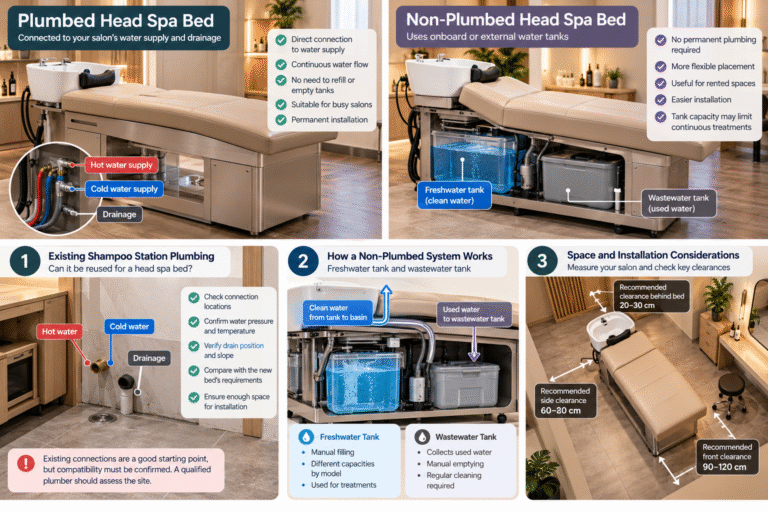
A plumbed head spa bed is designed to connect to a building’s water supply and drainage system.
Depending on the model, it may require:
- Cold water supply
- Hot water supply or a compatible water-heating arrangement
- Wastewater drainage
- Electrical power for any powered functions
- Appropriate access for installation and maintenance
Water can be supplied through the installed plumbing, and wastewater is directed into the drainage system.
This arrangement can be convenient for salons performing multiple head spa treatments throughout the day.
However, the installation must match the manufacturer’s specifications and applicable local plumbing and electrical requirements.
Advantages of Plumbed Head Spa Beds
- No routine manual refilling of a freshwater tank for the main water supply
- No routine manual emptying of a wastewater tank for the main drainage
- Potentially more convenient for frequent, back-to-back treatments
- Suitable for a planned, permanent treatment area
- May simplify daily water handling when properly installed
Potential Disadvantages
- May require plumbing modifications
- Installation costs depend on existing infrastructure
- Equipment positioning is less flexible once connected
- Leaks or drainage problems can interrupt operations
- Maintenance access must be considered during installation
A plumbed model is not necessarily maintenance-free. Hoses, fittings, filters, basins, and other water-contact components may still require inspection and cleaning.
2. What Is a Non-Plumbed Head Spa Bed?
A non-plumbed head spa bed typically uses an onboard or external freshwater reservoir and a separate wastewater collection system instead of permanent water supply and drainage connections.
Some models use integrated tanks, while others rely on external containers, pumps, or other accessories.
Product configurations vary significantly.
Importantly, non-plumbed does not necessarily mean completely portable, cordless, or installation-free.
Some models still require electrical power, appropriate floor conditions, water filling procedures, and regular tank maintenance.
Advantages of Non-Plumbed Head Spa Beds
- May avoid the need for permanent water supply and drainage connections
- Potentially useful in rented premises with plumbing restrictions
- Can offer greater flexibility in treatment-room placement
- May reduce certain initial installation requirements
- Useful where modifying existing plumbing would be difficult
Potential Disadvantages
- Freshwater tanks must be refilled
- Wastewater must be emptied and disposed of appropriately
- Tank capacity may limit consecutive treatments
- Water handling adds daily operational work
- Tanks and water-contact components require regular cleaning
- Water heating and temperature control depend on the specific design
For a busy salon, the time spent filling, emptying, and cleaning tanks should be considered part of the operating cost.
3. Plumbed vs. Non-Plumbed Head Spa Beds: Side-by-Side Comparison
| Feature | Plumbed | Non-Plumbed |
|---|---|---|
| Water supply | Connected to building supply | Usually freshwater tank |
| Wastewater | Connected to drainage | Usually collection tank |
| Installation | Requires compatible plumbing | Usually simpler water setup |
| Frequent treatments | Generally more convenient | Depends on tank capacity |
| Relocation | Requires disconnection | Potentially more flexible |
| Daily maintenance | Plumbing and equipment cleaning | Tank filling, emptying, and cleaning |
| Initial cost | Equipment plus possible plumbing work | Equipment plus tank-related accessories |
| Best suited for | Permanent, regularly used treatment areas | Spaces with plumbing constraints |
Important: This table describes typical configurations, not guaranteed specifications for every model. Always check the actual product documentation.
4. Can You Replace an Existing Shampoo Bowl with a Plumbed Head Spa Bed?
Often, an existing shampoo station is a promising location for a plumbed head spa bed because water supply and drainage connections may already be nearby. However, compatibility must be confirmed before installation.
Removing a shampoo bowl does not guarantee that the replacement equipment will connect directly.
There are several reasons.
Water Supply Connections May Be Different
The existing hot and cold water connections may be positioned for a traditional shampoo bowl rather than a head spa bed.
The new equipment may require different connection locations, fittings, pressure conditions, or water-temperature arrangements.
Ask the equipment supplier for a technical connection diagram before making modifications.
Drainage Location and Performance Matter
The existing drain may be too far from the new outlet, positioned incorrectly, or unsuitable for the equipment’s discharge requirements.
For gravity drainage, pipe routing and available fall may be important.
Some equipment may use a pump, but this must be confirmed from the specific model’s technical specifications.
Do not assume that an existing drain can be reused without checking its configuration, capacity, and applicable plumbing requirements.
The New Bed May Occupy More Floor Space
A traditional shampoo chair and basin have a different footprint from many full-length head spa beds.
Even if the plumbing connections are suitable, the room may not have enough space for:
- The complete bed dimensions
- Practitioner movement around the head area
- Safe client entry and exit
- Access to plumbing and electrical components
- Cleaning and maintenance
Measure the actual room and compare it with the manufacturer’s dimensioned drawing.
Electrical Requirements May Be Different
Some head spa beds include powered adjustments, heating, pumps, or other electrical functions.
These features may introduce requirements that did not exist for the original shampoo bowl.
Electrical connections must be appropriate for the destination market and installed according to applicable local requirements.
Professional Installation May Still Be Necessary
Before ordering, have a qualified local plumbing professional assess the existing connections against the manufacturer’s installation specifications.
Where electrical work is required, use an appropriately qualified electrical professional.
A photograph of the old shampoo station is useful for an initial discussion, but it is not sufficient to confirm installation feasibility.
5. Seven Things to Check Before Replacing a Shampoo Bowl
If you’re converting an existing shampoo station into a head spa treatment area, use this checklist before purchasing equipment.
- Existing water connections: Identify the hot and cold water supply locations and available connection details.
- Drainage: Check drain location, routing, and compatibility with the proposed equipment.
- Water pressure and temperature: Compare the site conditions with the manufacturer’s stated requirements.
- Available floor space: Measure the room, doorways, working clearances, and client access.
- Electrical supply: Confirm voltage, frequency, plug or connection requirements, and any installation restrictions.
- Landlord and local approvals: Check whether modifications are permitted and whether professional permits or inspections are required.
- Manufacturer documentation: Obtain the technical drawing and installation manual before committing to the order.
If these details are unknown, avoid relying on the appearance of the room alone.
6. Which Head Spa Bed Is Better for a Busy Salon?
For a permanent salon performing multiple head spa treatments daily, a properly installed plumbed model will often be the more convenient option.
Why?
Because staff can avoid repeatedly refilling freshwater tanks and emptying wastewater containers.
Consider a hypothetical salon offering six head spa treatments per day.
If each treatment consumes 20 litres of water, total daily water consumption would be approximately 120 litres.
With a usable freshwater tank capacity of 20 litres, that could mean roughly six full tank volumes of water over the day.
Actual consumption and refill frequency will vary by treatment, equipment design, and usable tank capacity. This example is only intended to illustrate the operational difference.
For a low-volume salon offering occasional head spa services, manual water handling may be manageable.
For a busy salon, it can become an important workflow consideration.
The relevant cost is not just the purchase price. It is the total cost and effort of operating the equipment.
7. When Might a Non-Plumbed Head Spa Bed Be the Better Choice?
Non-plumbed equipment can be particularly attractive when a salon cannot easily modify its existing infrastructure.
Examples include:
- A rented salon where permanent plumbing changes are restricted
- A treatment room located far from existing water connections
- A small business testing demand for head spa services
- A salon with relatively low treatment volume
- A space where future rearrangement is important
However, buyers should check the complete operating process before assuming a non-plumbed model will be more convenient.
For example, where will freshwater be obtained?
Where will wastewater be emptied?
How heavy will the filled or used-water containers be?
How will the tanks be cleaned and maintained?
What happens if a treatment requires more water than the available tank capacity?
These questions matter just as much as the initial installation cost.
8. What About Water Temperature and Heating?
Water temperature is an important part of the head spa treatment experience.
But the distinction between plumbed and non-plumbed does not, by itself, tell you how the water is heated.
Different products may use different arrangements.
Some depend on the building’s hot water supply. Others may include heating or temperature-control components.
Before purchasing, ask:
- How is the water heated?
- Does the equipment require an external hot water connection?
- Does it include temperature adjustment or monitoring?
- What are the required electrical specifications?
- Are there temperature limits or operating precautions?
- How should the water system be cleaned and maintained?
Do not assume that a non-plumbed model includes an integrated heater, or that every plumbed model provides automatic temperature control.
These features must be verified individually.
9. What Salon Equipment Distributors Should Know
For importers and distributors sourcing head spa beds from China, the plumbed-versus-non-plumbed decision is more than a technical specification.
It can influence which customers the product suits, how the equipment is sold, and what after-sales support is required.
Different Customers May Need Different Configurations
A salon chain planning new treatment rooms may prefer fixed plumbing connections.
A small independent salon upgrading an existing room may be more interested in a non-plumbed model.
That doesn’t mean every distributor needs to stock both types.
But understanding the intended customers’ installation conditions can help determine the right product range.
Technical Documentation Is Part of the Product
Distributors should request more than catalogue photographs and a basic specification sheet.
Useful documents include:
- Dimensioned product drawings
- Water inlet and outlet diagrams
- Installation and maintenance manuals
- Electrical specifications, where applicable
- Water pressure and temperature requirements
- Tank capacity and water-handling instructions for non-plumbed models
- Spare parts and after-sales support information
Clear technical information can help distributors answer customer questions before an order is placed.
Installation Compatibility Can Affect Customer Satisfaction
Imagine a distributor selling a plumbed head spa bed to a salon that assumes it can connect directly to an existing shampoo bowl’s plumbing.
The equipment arrives, but the connections do not match.
The salon may need additional plumbing work, delaying installation and creating unexpected expenses.
Even if the equipment itself is well manufactured, the customer may still be dissatisfied.
This is why installation requirements should be communicated before the sale, not discovered after delivery.
Compare the Complete Supply Package
When comparing manufacturers, importers should clarify exactly what is included.
For example:
- Are connection hoses and fittings included?
- Is the wastewater collection system included with non-plumbed models?
- Are pumps or heaters included, if required?
- Which components are available as spare parts?
- Are installation documents provided in English?
- Can the supplier confirm compatibility with the destination market’s electrical requirements?
- What support is available if a component fails?
Two products with similar photographs may differ significantly in their supplied accessories, technical requirements, and after-sales arrangements.
Comparing the complete package is more useful than comparing equipment prices alone.
10. How to Choose the Right Head Spa Bed: A Simple Decision Guide
Before choosing a model, work through these questions.
Question 1: Do You Have Suitable Existing Plumbing?
If yes, a plumbed model may be worth considering after a compatibility assessment.
If no, compare the cost of plumbing work with the operational requirements of a non-plumbed model.
Question 2: How Many Treatments Will You Perform?
Higher treatment volumes generally make continuous water supply and drainage more attractive.
Lower volumes may make tank-based operation manageable.
Question 3: Is the Installation Permanent?
For a long-term, fixed treatment room, permanent plumbing may be practical.
For spaces with restrictions or uncertain layouts, a non-plumbed configuration may offer advantages.
Question 4: Can Staff Manage the Water System?
For non-plumbed models, consider the time and physical effort involved in filling, moving, emptying, and cleaning tanks.
Question 5: Has the Supplier Provided Complete Technical Information?
Do not finalize the purchase until the relevant dimensions, connection requirements, operating instructions, and included accessories are clear.
The best head spa bed is the one that fits your space, treatment volume, and operating requirements — not simply the model with the longest feature list.
Frequently Asked Questions
Can I install a head spa bed where my shampoo bowl used to be?
Possibly. Existing water supply and drainage connections may be reusable, but their locations and specifications must be checked against the new head spa bed’s installation requirements. A qualified local installer should assess compatibility before installation.
Is a plumbed head spa bed better than a non-plumbed one?
Not always. Plumbed models are generally more convenient for frequent treatments in permanent salon spaces. Non-plumbed models may be more practical where fixed plumbing is unavailable or difficult to modify.
Does a non-plumbed head spa bed need electricity?
Some models do. Pumps, heating, powered adjustments, and other features may require electricity. Check the manufacturer’s specifications rather than assuming that non-plumbed means cordless.
How often do you need to refill a non-plumbed head spa bed?
It depends on the usable tank capacity and water consumption per treatment. Ask the supplier for tank specifications and estimate your expected daily usage before purchasing.
Can a non-plumbed head spa bed be used in a rented salon?
Potentially, yes. It may be useful where permanent plumbing modifications are restricted. However, buyers should still check lease conditions, electrical requirements, water handling, floor suitability, and applicable local rules.
Do plumbed head spa beds require professional installation?
They commonly require assessment and connection by a suitably qualified plumbing professional. Electrical work, where required, should also be handled by appropriately qualified personnel in accordance with local requirements.
Can a head spa bed use the same drain as a shampoo bowl?
Sometimes, but not automatically. Compatibility depends on the drain location, pipe routing, equipment discharge requirements, and local plumbing rules. The manufacturer’s technical drawings should be reviewed before installation.
What should distributors ask a head spa bed manufacturer?
Distributors should confirm water connection specifications, drainage requirements, electrical configuration, dimensions, included accessories, tank capacity where applicable, installation documentation, spare parts availability, and after-sales support.
Final Thoughts: Choose for the Salon, Not Just the Showroom
A head spa bed can look impressive in a product catalogue.
But once it reaches a real salon, practical questions become more important.
Will it connect to the existing plumbing?
Is there enough room for installation and treatment?
How much daily maintenance will it require?
Can the salon operate it efficiently during busy periods?
For salon owners, these questions help prevent expensive purchasing mistakes.
For importers and distributors, understanding the answers can improve product selection, customer guidance, and after-sales support.
Plumbed or non-plumbed? The better option is the one that works reliably in the customer’s actual operating environment.
And that’s something worth confirming before placing an order.
Technical note: This article provides general product-selection guidance. Installation requirements vary by model and location. Plumbing and electrical compatibility must be confirmed using manufacturer documentation and appropriately qualified local professionals.
For Importers, Distributors & Wholesale Buyers
Looking for Head Spa Beds or Other Salon Furniture?
Lohas Supply provides salon furniture and beauty equipment sourcing and supply from China for international importers, distributors, wholesalers, and salon chains. From head spa beds and shampoo units to styling chairs, mirrors, and salon workstations, we help buyers explore suitable products, coordinate with suppliers, and manage quality requirements.
Explore Our Products
info@lohaschinasourcing.com