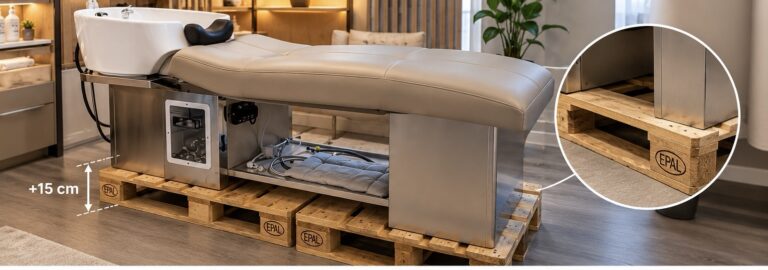
Consider a head spa practitioner who needs to raise a treatment bed by approximately 15 cm to achieve a more comfortable working position.
The equipment has a long, continuous base rather than four accessible legs, making conventional furniture risers difficult to use.
One improvised solution is to place two wooden shipping pallets beneath the equipment.
At first glance, it seems simple, inexpensive and practical.
But would the pallets remain stable when clients get on and off the bed? Could moisture affect their long-term durability? And is the equipment’s weight distributed safely across the supporting structure?
For salon equipment importers and distributors, this is more than an unusual installation workaround. It highlights a product design issue that may not become obvious until equipment is used in a real salon.
Why Does Head Spa Bed Height Matter?
Head spa equipment combines several functions that can make ergonomic design more complicated than it first appears.
Depending on the model, it may include a reclining treatment surface, shampoo basin, water supply and drainage connections, electrical controls and additional treatment features.
The practitioner needs comfortable access to the client’s head and neck, while the client needs to enter, lie down and leave the equipment safely.
One fixed height may not suit everyone.
A shorter practitioner may prefer a lower working position. A taller practitioner may need additional height to avoid repeatedly bending forward.
Different treatment techniques can also require different working postures.
When equipment is too low, the problem is not merely inconvenience.
Repeated awkward bending and reaching may contribute to physical discomfort over time.
That makes working height a legitimate purchasing consideration, not simply a personal preference.
Can Wooden Pallets Be Used to Raise a Head Spa Bed?
Wooden shipping pallets are designed to support goods during storage and transportation.
Some pallet designs can carry substantial loads under specified conditions.
However, there is an important distinction:
A pallet’s ability to support freight does not automatically make it suitable as a permanent support for equipment carrying a person.
Several factors need to be considered.
1. Load Distribution
Where does the equipment transfer its weight onto the pallet?
A continuous metal base may rest on several wooden boards, but that does not necessarily mean the load is distributed evenly.
Some sections may carry more weight than others.
Without knowing the equipment’s construction and the pallet’s structural characteristics, it is difficult to assess the arrangement reliably.
2. Stability During Client Movement
A head spa bed may appear stable when nobody is using it.
But the loading conditions change when a client sits on the edge, climbs onto the bed, changes position or gets off.
These movements may introduce uneven loading and lateral forces.
If the equipment is not properly secured to its supporting structure, shifting or instability may become a concern.
3. Moisture and Cleaning
Head spa treatments involve water, making moisture resistance particularly important.
Wooden pallets may be exposed to splashes, cleaning water, leaks or persistent humidity.
Depending on their condition and treatment, prolonged moisture exposure can contribute to deterioration or hygiene and maintenance problems.
Even a pallet manufactured to recognised shipping standards is not necessarily suitable for permanent installation in a wet salon environment.
4. Long-Term Maintenance
Salon equipment is expected to withstand repeated daily use.
A temporary arrangement that appears satisfactory initially may not provide the same level of reliability over months or years.
For equipment used by paying clients, installation safety should not depend on assumptions about the strength of improvised materials.
Why Heavy-Duty Furniture Risers May Not Solve the Problem
Furniture risers are commonly used to increase the height of beds, desks and other household furniture.
Some are advertised with substantial weight capacities.
However, many risers are designed for furniture with individual legs.
A head spa bed with a long, continuous base may not have suitable contact points for these products.
Even when a riser appears to fit, its advertised weight rating alone does not establish compatibility with a particular piece of salon equipment.
The complete installation must account for load distribution, movement, restraint and the manufacturer’s requirements.
The important question is not simply whether a support can hold the weight. It is whether the complete arrangement remains safe during normal use.
What Are the Better Options for Head Spa Bed Height Adjustment?
There is no universal solution because head spa beds vary considerably in construction.
Before modifying equipment, buyers should consult the manufacturer or a suitably qualified installer.
Option 1: Select the Right Working Height Before Purchasing
For new salon projects, prevention is usually easier than modification.
Buyers should request detailed dimensions rather than relying only on catalogue photographs.
Important measurements may include:
- Overall equipment height
- Shampoo basin rim height
- Headrest and treatment surface height
- Working clearance around the basin
- Client entry and exit height
These measurements should be compared with the intended treatment procedures and practitioner requirements.
Option 2: Consider Height-Adjustable Equipment
Some salon and treatment equipment offers height-adjustment functions.
Depending on the design, adjustment may be manual, hydraulic or electric.
For salons employing practitioners of different heights, this flexibility can be valuable.
However, buyers should confirm the actual adjustment range, rated capacity and whether the mechanism is suitable for the intended treatment.
Not every height-adjustable beauty bed is suitable for head spa applications involving integrated plumbing.
Option 3: Use a Manufacturer-Approved Support Solution
Where an existing head spa bed needs to be raised, the manufacturer may be able to advise whether a compatible support or modification is available.
Any purpose-designed support should account for:
- Equipment weight and rated user load
- Load-bearing contact points
- Prevention of sliding or tipping
- Floor conditions
- Moisture resistance and cleanability
- Plumbing and electrical connections
- Safe client access
A modification should be assessed before the equipment is returned to client use.
Option 4: Review the Complete Workstation Layout
Sometimes, working height is only part of the ergonomic problem.
Practitioner seating, access around the basin, treatment technique and available working space may also affect comfort.
Raising the entire bed can create a new problem if clients find it more difficult to get on and off.
A suitable solution needs to work for both the practitioner and the client.
What This Reveals About Head Spa Equipment Design
For manufacturers, installation difficulties can reveal opportunities for product improvement.
When users need to modify equipment to achieve a comfortable working position, it is worth investigating whether the original design provides enough flexibility.
For example:
- Could the product be offered in different height configurations?
- Would an adjustable basin position improve ergonomics?
- Could an approved base-height option be developed?
- Are the installation dimensions clearly communicated before purchase?
- Would better technical documentation prevent unsuitable modifications?
Not every product needs an expensive electric lifting system.
Additional mechanisms can increase manufacturing costs, complexity and maintenance requirements.
But understanding real installation challenges can help manufacturers make better design decisions.
Sometimes, the most useful product development insight comes from understanding what users are trying to change about an existing product.
What Importers and Distributors Should Check Before Ordering Head Spa Beds
For salon furniture importers and distributors, equipment selection should go beyond appearance, features and factory price.
Installation compatibility can directly affect customer satisfaction and after-sales costs.
Before placing a wholesale order, consider requesting the following information from your China supplier:
- Detailed dimensions: Including basin, headrest and treatment surface heights.
- Installation instructions: Including required floor conditions and positioning.
- Rated load: With clear information about applicable loading conditions and limitations.
- Base construction: Including load-bearing contact points and structural details.
- Plumbing requirements: Including water supply and drainage connections.
- Electrical requirements: Where powered functions are included.
- Available configurations: Including height options and manufacturer-approved accessories.
- After-sales support: Including technical documentation, spare parts and installation guidance.
These questions become particularly important when distributors sell equipment to multiple salons with different layouts and operating requirements.
A product that works well in one showroom may not fit every salon environment.
For international buyers, applicable product safety and installation requirements may also differ between markets.
Why This Matters for Salon Equipment Distributors
Distributors often compete on product selection, pricing and delivery.
But installation knowledge and after-sales support can also create meaningful differentiation.
Consider two suppliers offering similar head spa beds.
One provides attractive photographs and a competitive quotation.
The other also provides clear working dimensions, installation guidance, technical drawings and realistic information about product limitations.
For a professional distributor, the second supplier may offer greater long-term value.
Better product information can help reduce misunderstandings before an order is placed.
It can also make it easier for distributors to advise salon customers and coordinate installation support.
A good product is not just one that looks impressive when delivered. It is one that can be installed, operated and maintained appropriately in its intended environment.
Final Thoughts: Small Installation Problems Can Reveal Bigger Product Issues
Raising a head spa bed by 15 cm may sound like a minor adjustment.
But the issue involves much more than height.
It touches on ergonomics, structural support, client access, moisture exposure, product documentation and after-sales service.
Improvised wooden pallets should not be treated as a safe installation solution without appropriate engineering assessment and approval.
For salon owners, the better approach is to choose equipment that suits the intended working environment or obtain a properly assessed modification.
For importers and distributors, the lesson is broader.
Product quality is not only about materials, appearance or factory inspection. It is also about whether the equipment works properly in the customer’s real operating environment.
And that is something worth checking before the next container leaves China.
Sourcing Head Spa Beds for Your Market?
Lohas Supply supports international importers, distributors and salon equipment businesses with head spa beds, salon furniture supply and China-side sourcing coordination. We help buyers clarify specifications, communicate with manufacturers, coordinate customization and arrange quality inspections.
Explore Our China Sourcing Services
Or email us at info@lohaschinasourcing.com