Imagine renovating a hair salon.
You want a cleaner, more modern interior. Matching mirrors, warm wood finishes, integrated countertops and enough storage to keep styling tools out of sight.
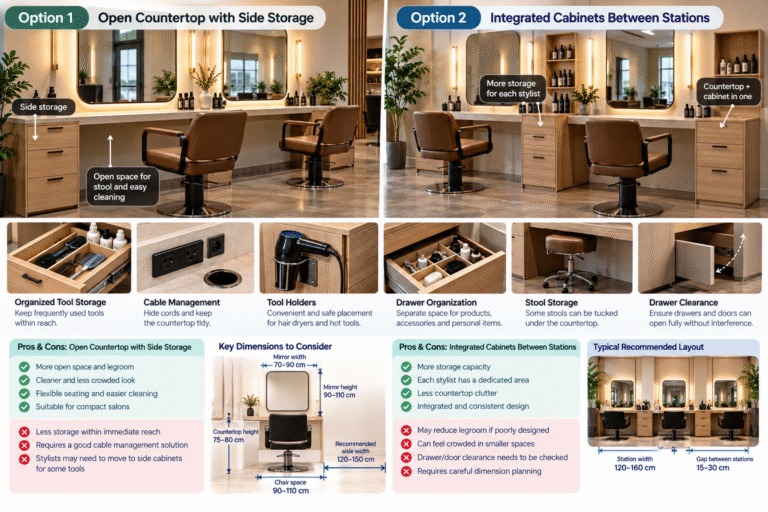
Two styling station designs catch your attention.
The first features a continuous countertop with open space underneath. Electrical cords can be concealed, and stools can slide beneath the work surface.
The second includes additional cabinets between the styling chairs. Each stylist gets more dedicated storage, and the cabinets also provide usable countertop space.
Both designs look attractive.
But which one will actually work better when the salon is busy?
This is where salon furniture design becomes more than an aesthetic decision. It becomes a question of workflow, ergonomics and how people use the space every day.
1. The Storage vs. Space Dilemma
Salon styling stations have to accommodate more than mirrors and chairs.
A typical stylist may need convenient access to:
- Hair dryers and styling irons
- Brushes, combs and clips
- Spray bottles and styling products
- Electrical outlets and charging points
- Personal tools and small accessories
- Cleaning supplies and waste disposal
Without adequate storage, countertops can quickly become cluttered.
But adding more cabinets is not always the solution.
Every cabinet occupies physical space. Depending on its position, it may restrict movement, interfere with seating or make the workstation feel crowded.
For salon owners, the challenge is to find the right balance between accessible storage and comfortable working space.
2. Option A: Open Countertops with Storage at the Sides
One approach is to use a continuous countertop while keeping the area beneath the main styling position relatively open.
Storage can be integrated into side cabinets, drawers or separate towers.
Potential Advantages
- More open space: The workstation may feel less crowded.
- Flexible seating: Some stools can be tucked beneath the counter when not in use.
- Cleaner appearance: A continuous surface can create a streamlined interior.
- Better flexibility: Open space beneath the counter may accommodate different working preferences.
- Easier access: Depending on the design, the floor and wall area may be easier to reach for cleaning or maintenance.
Potential Drawbacks
Open countertops do not automatically solve storage problems.
If the drawers and side cabinets are too far away, stylists may have to move repeatedly to retrieve tools.
And without a dedicated cable-management system, an open workstation can quickly become a collection of visible wires.
The key is not simply removing cabinets.
It is ensuring that frequently used tools remain accessible without interfering with movement.
3. Option B: Styling Stations with Integrated Lower Cabinets
Another approach places cabinets directly beneath the countertop or between styling positions.
This can provide dedicated storage for each stylist and reduce the need for separate furniture.
Potential Advantages
- More storage capacity: Drawers and cabinets keep products and tools organized.
- Defined workstations: Each stylist can have a designated storage area.
- Integrated design: Cabinets, countertops and mirrors can share a consistent finish.
- Less countertop clutter: Frequently used items can be stored nearby.
Potential Drawbacks
The main concern is where the cabinets are positioned.
A cabinet placed directly in front of a styling chair may reduce available legroom or interfere with the stylist’s working position.
Depending on the dimensions, it may also limit where a stool can be positioned.
Cabinets between stations may work well, but only if sufficient clearance remains around the chairs.
One common design mistake is evaluating the furniture without considering the space occupied by the stylist, client and chair during actual use.
A cabinet can be useful for storage and still be in the wrong place.
4. The Real Question: Where Should the Storage Go?
Instead of asking whether a styling station should have cabinets, consider a more useful question:
Which storage needs to be within immediate reach, and which items can be stored elsewhere?
Hair dryers, brushes and styling tools may need quick access throughout the day.
Extra product inventory, spare equipment and less frequently used supplies may not.
This distinction can influence the entire workstation design.
For example, a salon might combine:
- A clear main countertop for active styling work
- Side drawers for frequently used tools
- Vertical cabinets for additional supplies
- Dedicated holders for hair dryers and heated tools
- Concealed cable channels and accessible outlets
The best arrangement depends on the salon’s services, available floor area and how individual stylists work.
For a compact salon, careful placement may be more valuable than simply adding another cabinet.
5. Cable Management Deserves More Attention
One detail often overlooked in salon styling station design is electrical cable management.
Hair dryers, straighteners, curling irons and other powered tools are used repeatedly throughout the working day.
A beautifully designed countertop can become inconvenient if electrical outlets are poorly positioned.
Loose cables may create clutter, interfere with movement or become exposed to heat and moisture.
Before purchasing styling stations, buyers should consider:
- Where the salon’s electrical outlets are located
- Whether the workstation includes suitable cable openings
- How cords will be routed and kept away from walkways
- Whether cable channels remain accessible for maintenance
- Where heated tools can be placed safely after use
- Whether any integrated electrical components meet applicable local requirements
A cable grommet is a useful detail, but it is not a complete electrical safety solution.
For international buyers, electrical specifications and installation requirements should be confirmed before production.
Furniture designed for one market may need changes before being installed in another.
6. Don’t Judge a Styling Station by Its Rendering
Modern design software and AI-generated interior images make it easier than ever to visualize an attractive salon.
That can be helpful when comparing finishes, furniture arrangements and overall style.
But a rendering cannot establish whether the proposed layout will work comfortably in real life.
It may not accurately represent:
- The clearance needed around a styling chair
- The space occupied by a stylist during a service
- Drawer opening clearance
- Actual cabinet dimensions
- Access to electrical outlets
- Cleaning and maintenance requirements
Even dimension labels shown in a concept image should be checked against measured drawings.
For example, a cabinet that appears slim in a rendering may be deeper than expected once the actual product specifications are reviewed.
Likewise, a beautifully balanced row of styling stations may feel crowded when all chairs are occupied.
Renderings help buyers imagine a space. Technical drawings help them understand whether it can work.
7. Five Measurements to Check Before Ordering
For salon owners, distributors and project buyers, a few practical measurements can prevent expensive mistakes.
Station Width
Check the overall width of each workstation, including side cabinets and any gaps required between units.
The furniture should be evaluated alongside the space required for the styling chair and surrounding activity.
Countertop Depth
A deeper countertop may provide more room for tools and products, but it can also affect reach and working posture.
The appropriate depth depends on how the station will be used.
Countertop Height
Working height influences comfort and access to tools.
Consider whether the proposed height suits the intended users and salon workflow.
Cabinet and Drawer Clearance
Check whether drawers and doors can open fully without interfering with chairs, stools or adjacent furniture.
This is especially important when cabinets are placed between styling positions.
Electrical Access
Confirm the location of cable openings, outlets and any integrated electrical components.
Electrical planning should be coordinated with the salon’s actual installation conditions.
8. What Salon Furniture Importers and Distributors Should Ask Manufacturers
For importers sourcing salon styling stations from China, design flexibility can be an important purchasing consideration.
Two models may look similar in a catalogue but offer very different installation and customization possibilities.
Before placing a wholesale order, consider asking suppliers:
- Can the cabinet position be changed from front to side?
- Are different countertop widths and depths available?
- Can drawers, shelves or storage towers be added or removed?
- Are cable grommets and tool holders available?
- Can the supplier provide dimensioned technical drawings?
- What materials and surface finishes are used?
- How are the units packaged for international shipping?
- What assembly and installation work is required after delivery?
- Which modifications are available under the proposed order quantity?
Not every manufacturer will support every customization request.
Changes to cabinet dimensions, structure, materials or electrical components may affect minimum order quantities, pricing and lead times.
That is why specifications should be clarified before quotations are finalized.
For distributors, a modular product range with clear options may also be easier to sell to salons with different floor plans.
9. Why Better Workstation Design Can Reduce After-Sales Problems
For salon furniture distributors, the transaction does not necessarily end when the goods arrive.
Customers may have questions about installation, missing dimensions, electrical access or how the furniture fits their existing space.
Some problems are difficult to resolve once fixed cabinetry has been installed.
A customer who discovers that a cabinet obstructs movement may not be satisfied simply because the furniture looks beautiful.
For this reason, product usability deserves attention during sourcing and selection.
Clear specifications, suitable configuration options and accurate installation information can help buyers make more informed decisions.
They can also reduce avoidable misunderstandings between manufacturers, distributors and salon owners.
Good salon furniture design should support the work happening around it, not force people to work around the furniture.
10. So, Which Design Is Better?
There is no universal winner between open countertops and integrated cabinets.
An open workstation may be preferable where flexibility, movement and a less crowded appearance are priorities.
Integrated cabinets may be preferable where individual storage is essential and sufficient clearance is available.
For many salons, a combination may be worth considering: an open central working area with well-positioned side storage.
But the final decision should be based on measured dimensions, actual workflow and the needs of the people using the equipment.
The most attractive layout is not necessarily the most practical one.
Final Thoughts: Design for the Working Day, Not Just the Photograph
Salon renovations often begin with a vision of how the finished space should look.
That matters. A well-designed salon can help communicate a brand’s identity and create a welcoming customer experience.
But the furniture also has to work.
Stylists need accessible tools, comfortable movement and practical storage.
Salon owners need efficient use of floor space and furniture that can withstand daily operation.
Distributors need products that can be specified, installed and supported with confidence.
When choosing salon styling stations, don’t ask only how much storage you can fit into the design.
Ask how much usable working space you can preserve.
Sometimes, the difference between a beautiful salon and a functional one is simply where the cabinets are placed.
Sourcing Salon Styling Stations from China?
Lohas Supply works with international importers, distributors and salon furniture buyers. We help coordinate salon styling station supply, product specifications, customization discussions, supplier communication and quality inspections.
Explore Our China Supply Services
Or contact info@lohaschinasourcing.com