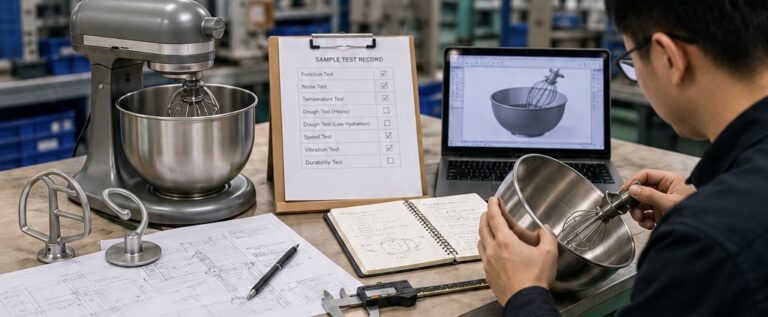
A product development problem that looked relatively small eventually took months to resolve. The buyer had a Chinese supplier, working prototypes, and later even an independent engineering team. Yet progress remained slow — revealing a problem many overseas buyers underestimate when developing products in China: finding a supplier is not the same as finding a supplier capable of solving engineering problems and executing changes efficiently.
When overseas buyers source a new product from China, the most visible costs are easy to calculate: tooling, samples, unit price, inspection fees, freight, and sourcing fees.
What is much harder to see is the cost of lost development time.
This case study comes from a real consumer-product development project involving a Chinese supplier. The names of the buyer and supplier have been removed for confidentiality, but the sourcing and product-development challenges are real.
The case illustrates an important lesson: a supplier may be capable of manufacturing a product without necessarily having the engineering capability, testing discipline, or project-management structure required to solve complex product-development problems.
The Project: Developing a Household Stand Mixer
The buyer was developing a household stand mixer with a Chinese supplier.
The project had already progressed well beyond the basic sourcing stage. Samples had been produced, the product was being tested, and the buyer expected the supplier to continue refining the design toward stable production.
However, several functional issues began to appear during real-world use.
Among the concerns were the interaction between the mixing bowl and the mixing tools, including the working clearance between the tools and the bowl, the way dough behaved during kneading, and whether the bowl and tool geometry were properly matched across different operating conditions.
Some problems did not appear consistently during the supplier’s own testing, which made troubleshooting even more difficult.
The Problem Was Not Simply “A Bad Part”
At first glance, issues like these can look relatively simple.
A supplier may suggest changing a whisk, adjusting a beater, modifying a component, or producing another sample.
But mechanical products often behave as systems.
The bowl shape, tool geometry, rotational path, clearances, assembly tolerances, motor load, transmission, materials, and the characteristics of the food being processed can all interact.
For example, a stand mixer tested with one dough recipe may behave differently when the customer uses:
- a heavier dough load;
- a lower-hydration dough;
- a different flour type;
- a longer kneading cycle; or
- a different operating speed.
This means that a problem observed by the end user may not be reproduced easily by a factory unless the testing conditions are properly defined and controlled.
Quick Fixes vs. Root-Cause Analysis
The buyer became increasingly frustrated because the supplier appeared to respond to problems mainly through individual adjustments and repeated trial-and-error.
A component would be changed, another sample would be made, and the buyer would test again.
Sometimes the immediate symptom improved, but the buyer still lacked confidence that the underlying cause had actually been identified.
This distinction matters.
A quick fix asks: “What can we change to make this symptom disappear?”
Root-cause analysis asks: “Why is this happening, under which conditions does it happen, and how do we verify that the proposed solution has actually solved the underlying problem?”
The second approach requires more than manufacturing capability. It requires engineering discipline, repeatable testing, documentation, and clear responsibility inside the supplier’s organization.
A Major Warning Sign: Limited Visibility Into the Supplier’s Engineering Process
Another difficulty was visibility.
The buyer mainly communicated with one commercial contact at the supplier.
He had very limited visibility into:
- who was actually responsible for engineering;
- who was conducting product testing;
- how many people were working on the project;
- what their engineering capabilities were;
- what testing procedures were being followed; or
- which parts of development and manufacturing were performed in-house.
This does not automatically mean the supplier was dishonest or that it was not a real manufacturer.
Many Chinese suppliers use a mixture of in-house production, outsourced components, external tooling suppliers, and subcontracted engineering resources.
However, when a technically demanding product is being developed, the buyer needs to understand who is actually doing what.
If engineering information is repeatedly passing through a salesperson before reaching the people who actually build and test the product, communication losses can become a serious problem.
The Buyer Eventually Hired an Independent Engineering Team
After months of troubleshooting, the buyer brought in an independent engineering team.
This changed the development process significantly.
Instead of continuing to modify isolated components, the engineers began reviewing the product more systematically.
One of the first major steps was a redesign of the mixing bowl. After completing the bowl redesign phase, the engineering team moved on to redesigning the mixing tools.
This does not by itself prove that bowl-and-tool geometry was the only root cause of the earlier problems.
However, it does show that the engineering team considered the relationship between these components important enough to revisit at system level rather than continuing with isolated adjustments.
The buyer also began receiving more structured engineering information, testing feedback, and quality-assurance input than he had previously received from the supplier.
Manufacturing Capability Is Not the Same as Engineering Capability
This case highlights a distinction that many first-time importers learn only after something goes wrong:
A factory that can manufacture a product is not necessarily a factory that can engineer a product.
A production-oriented factory may be very good at:
- manufacturing an existing design;
- buying components from established suppliers;
- assembling products efficiently;
- controlling production cost; and
- repeating a mature process.
But new product development may require different capabilities:
- mechanical analysis;
- root-cause investigation;
- tolerance analysis;
- structured prototype testing;
- design validation;
- failure analysis; and
- documentation of engineering changes.
Some manufacturers have strong internal R&D teams. Others do not.
The mistake is assuming that because a supplier says, “Yes, we can make this,” it also means, “Yes, we can independently solve every engineering problem that appears during development.”
Even a Good Engineering Team Does Not Solve the Entire Supply-Chain Problem
Hiring an independent engineering team was a major step forward, but it created another important interface:
Engineering design still has to be translated into factory execution.
A technically correct CAD model or engineering specification does not automatically guarantee a correct production result.
The factory still has to:
- understand the engineering changes;
- confirm manufacturability;
- apply the correct tolerances;
- modify tooling or components where necessary;
- produce new samples;
- test them under appropriate conditions;
- report problems accurately; and
- implement the approved design consistently during production.
This is where China-side supplier management can become just as important as engineering.
The engineering team may define what should happen.
Someone still needs to make sure the supplier actually makes it happen.
Could an Earlier Factory Visit Have Helped?
No sourcing agent should claim that one factory visit can magically solve a mechanical engineering problem.
However, an early on-site assessment could potentially have revealed important information much sooner.
For example:
- Is there an identifiable engineering team?
- Can the engineers explain the problem directly?
- What testing equipment and procedures are actually being used?
- Can the supplier reproduce the customer’s reported problem?
- Which components are manufactured internally?
- Which processes are outsourced?
- Who has authority to approve design changes?
- Does the supplier use documented testing and corrective-action procedures?
These questions are difficult to answer from overseas when all communication is filtered through a single sales contact.
An experienced local sourcing or supplier-management professional cannot replace an engineer, but they can help a buyer understand whether the supplier has the organization and capabilities required to execute the engineering work.
The Hidden Cost Was Not the Sourcing Fee
During early-stage sourcing, buyers often focus heavily on visible service costs.
A factory visit, supplier audit, sourcing consultant, project coordinator, or production-follow-up service may look like an additional expense.
But in product development, the much larger cost can be months of uncertainty.
During those months:
- the product is not generating revenue;
- competitors may continue improving their products;
- advertising trends may change;
- consumer interest may shift;
- inventory planning is delayed;
- cash remains tied up in development; and
- the founder spends time learning and coordinating tasks outside their core expertise.
A buyer may save hundreds or a few thousand dollars in professional support while losing far more through delayed time-to-market.
Product Trends Do Not Wait for Your Development Schedule
This is especially important for consumer products influenced by social media, online advertising, or fast-moving e-commerce trends.
A product can still be commercially viable after a long development cycle, but the most profitable market window may already have started closing.
The question is therefore not simply:
“How much does professional sourcing or supplier management cost?”
A more useful question is:
“What would one additional month of development delay cost my business?”
For an established industrial product, that delay may be manageable.
For a trend-driven consumer product, it can be far more expensive than the sourcing fee the buyer originally wanted to avoid.
When Should You Consider Changing Suppliers?
Engineering problems do not automatically mean a supplier should be replaced.
If the supplier manufactures well but has limited R&D capability, an independent engineering team combined with strong production follow-up may be a workable structure.
However, once the design has been properly validated, it may be worth reassessing the manufacturer if problems also exist in areas such as:
- testing discipline;
- communication transparency;
- quality control;
- production execution;
- responsiveness to engineering changes; or
- ability to identify and escalate problems.
At that point, the question is no longer simply whether the supplier can produce the product.
The question becomes whether it is the right manufacturing partner for scaling the product reliably.
Key Lessons for Overseas Buyers Developing Products in China
- Do not confuse manufacturing ability with engineering ability. Verify both separately.
- Understand who is actually working on your product. Sales, engineering, QC and production should not be a black box.
- Repeated trial-and-error is a warning sign. Ask how the root cause is being identified and how the solution will be validated.
- Define realistic test conditions. Products must be tested under conditions representative of actual customer use.
- Manage the engineering-to-production handover. A good design still requires disciplined factory execution.
- Evaluate time-to-market as a cost. The cheapest sourcing approach is not always the lowest-cost business decision.
- Reassess the supplier when necessary. Loyalty to an existing supplier should not outweigh evidence that another manufacturer may execute the product better.
China Sourcing Is Not Just About Finding a Factory
Finding a supplier is often the easiest part.
The harder work begins when a product needs to move from idea to sample, from sample to validated design, and from validated design to repeatable mass production.
That process may involve engineers, factories, tooling suppliers, component suppliers, inspectors, freight partners and the buyer’s own team.
The value of a capable China-side sourcing partner is not simply having access to supplier names.
It is helping the buyer reduce information gaps, identify supplier-capability problems earlier, keep the factory accountable, and shorten the path from product development to reliable production.
Developing or Sourcing a Product in China?
If you need independent supplier screening, factory visits, supplier evaluation, production follow-up or China-side sourcing support, Lohas Supply can assist as your local sourcing partner.