It is how the structure of the market affects equipment demand.
A recent Modern Salon feature described salon visits as part of a frequent beauty routine for many clients in Dubai. Gaurav Tripathi of MADI International estimated that some regular clients may spend roughly US$800 to US$1,400 per month on salon and beauty services.
That figure should not be treated as an average for the entire Dubai population. But it does highlight an important characteristic of the market: for a meaningful segment of customers, professional beauty is not an occasional purchase. It is part of a recurring lifestyle.
For salon chains, distributors and equipment suppliers, that has implications far beyond simply selling more expensive furniture.
What Professional Buyers Should Take Away
- Premium salon demand does not automatically mean that the most expensive equipment is the right equipment.
- High service frequency makes durability, maintenance and downtime more commercially important.
- Dubai is increasingly connected to beauty, wellness, technology and premium service concepts rather than traditional hair services alone.
- The UAE can be an important commercial gateway, but it should not be treated as representative of every GCC market.
- For distributors, a carefully segmented product range may be more valuable than a very large catalog.
A High-Spending Market Changes the Equipment Conversation
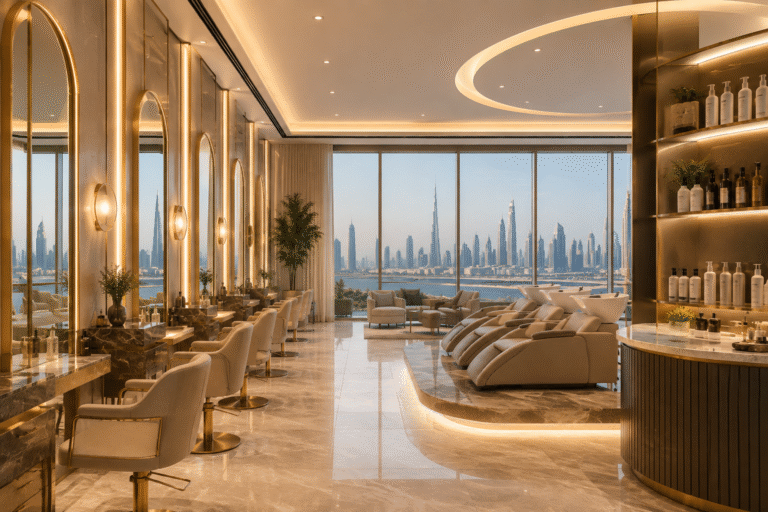
When suppliers hear the words “Dubai salon,” the immediate reaction is often to recommend luxury finishes: gold details, marble-effect surfaces, oversized chairs, decorative lighting and premium upholstery.
There is clearly a market for visually distinctive equipment.
But professional buyers need to look beyond appearance.
If customers visit salons frequently and salons operate at high service intensity, equipment also needs to perform repeatedly under commercial conditions.
This makes questions such as these increasingly important:
- How easily can the upholstery be cleaned between services?
- Can frequently used components be replaced without replacing the whole unit?
- How accessible are pumps, motors, controls or plumbing components for maintenance?
- Can replacement parts be identified several years after the original purchase?
- Will the supplier maintain the same finish, material and component specification across repeat orders?
- How difficult is the product to repair locally if something fails?
In a high-value salon environment, equipment downtime can cost far more than the replacement part itself.
A US$20 or US$50 component can become a much larger commercial problem if a treatment station cannot be used for several weeks.
Beauty and Wellness Are Becoming Harder to Separate
Another reason Dubai deserves attention is the growing overlap between beauty, wellness and professional services.
The 2026 Beautyworld Dubai program reflects this direction. Alongside traditional hair, nail and salon supply categories, the event is highlighting beauty technology, innovation, wellness and business models that combine several professional beauty services.
The conference agenda includes discussions around salon expansion, the GCC beauty market, beauty retail, longevity and the integration of wellness across spa, retail and hospitality models.
For salon equipment buyers, this matters because the definition of a “salon” is becoming less rigid.
A modern operator may combine:
- hair services;
- scalp and head spa treatments;
- nail and pedicure services;
- facials and skincare;
- massage or relaxation treatments;
- premium retail products;
- private treatment rooms;
- wellness-oriented experiences.
As service menus broaden, furniture requirements can change as well.
The purchasing question becomes less about furnishing one traditional salon format and more about designing equipment packages around different revenue-generating service zones.
Premium Does Not Have to Mean Maximum Complexity
There is another trap that equipment distributors should watch carefully.
When a market is perceived as premium, manufacturers often respond by adding functions.
Electric adjustment, heating, massage, water circulation, electronic controls, lighting, multiple motors and multifunctional treatment systems can all make a product look more advanced.
But every additional function also introduces another component that may eventually require maintenance.
This does not mean that complex equipment should be avoided.
It means buyers should ask whether each function creates enough commercial value to justify the additional installation and after-sales requirements.
A premium salon may actually value reliable operation, quiet performance, refined design and easy maintenance more than a long list of functions that staff rarely use.
Head Spa and Multi-Service Equipment Are Worth Watching
The growing connection between beauty and wellness also helps explain why categories such as head spa equipment, premium shampoo systems and multi-service treatment furniture are receiving more attention.
But equipment buyers should avoid assuming that every salon needs the same configuration.
A dedicated head spa studio can design its rooms around permanent equipment and specific plumbing requirements.
An established hair salon adding one new scalp-care service may have much less space and may want to work around an existing shampoo area.
A luxury beauty destination may prioritise privacy, comfort and design.
A chain operator may care more about repeatability, installation consistency and spare-parts management across multiple branches.
These businesses are all participating in the same broad beauty-and-wellness trend, but their procurement requirements can be very different.
Dubai Is Important, but “The Middle East” Is Not One Market
One of the most important cautions for overseas suppliers is to avoid treating Dubai, the UAE and the entire Middle East as interchangeable markets.
Industry research published by Beautyworld and BeautyMatter has highlighted the significant differences between countries in the region.
Commercial expectations in the UAE may differ from Saudi Arabia, Kuwait, Qatar or other markets in areas including consumer preferences, distribution structures, regulation, price positioning and local business practices.
For an equipment distributor, this means that a product range successful in Dubai should not automatically be copied into every GCC market without further validation.
Dubai can be an excellent place to observe premium concepts and international beauty trends, but regional expansion still requires local market judgement.
What Beautyworld Dubai Tells Us About the Buying Environment
Beautyworld Dubai will hold its 30th edition from 6–8 October 2026 at the Dubai World Trade Centre.
The significance is not simply the size of the exhibition.
The product structure of the event shows how the regional beauty business is developing.
The exhibition now connects areas such as:
- hair, nails and professional salon supplies;
- beauty technology;
- cosmetics and skincare;
- wellness;
- packaging;
- contract manufacturing;
- machinery;
- distribution and supply-chain services.
For professional buyers, this increasingly creates a market in which salon equipment is only one piece of a broader beauty business ecosystem.
A distributor that once sold mainly salon chairs or shampoo units may eventually find opportunities in adjacent categories such as scalp-care equipment, spa furniture, beauty devices or other professional treatment systems.
The opportunity is therefore not necessarily to sell more individual products.
It may be to understand how the customer’s business model is changing and build a more relevant product portfolio around that change.
What This Means for Equipment Distributors
For distributors considering the UAE market, one useful approach is to think in terms of product roles rather than simply product quantities.
A range might include:
1. The Commercial Core
Reliable equipment that can be sold repeatedly to working salons and supported efficiently after installation.
This is often where durability, component availability and consistent production matter most.
2. The Premium Upgrade
Products with stronger visual design, materials or comfort features for salons targeting a higher-end customer experience.
The important question is whether the premium is visible and meaningful to the salon owner and end customer.
3. The Innovation Product
A newer category such as head spa equipment, multifunctional treatment furniture or a technology-enabled device that gives distributors access to an emerging service trend.
These models may deserve smaller trial quantities until after-sales performance and customer demand are better understood.
4. The Project Product
Furniture or equipment intended for larger salon openings, hotel spas, chains or customised interiors.
Here, consistency, project coordination, colour matching and production scheduling can become as important as unit price.
What China-Based Sourcing Adds to the Equation
China offers a very broad supply base for salon furniture and beauty equipment, and new designs can appear quickly when a category gains market attention.
That variety creates opportunity, but it also makes comparison more difficult.
Two products that look almost identical in supplier photographs may use different pumps, motors, frames, upholstery, control systems, drainage arrangements or packaging methods.
This becomes particularly important when a distributor intends to sell the product repeatedly rather than make a one-time purchase.
For buyers building a UAE or GCC product range from China, the sourcing challenge is therefore not simply finding attractive models.
It is identifying which supplier and configuration fit the intended market position, and then clarifying the specifications that matter for repeat orders and after-sales support.
Lohas Supply works with international buyers to compare Chinese suppliers, clarify product configurations, coordinate sourcing and support quality control before shipment.
Before Adding a New Product to a Dubai Range
A distributor does not need a complicated scoring system for every product, but several practical questions are worth answering:
- Which type of salon is this product actually for?
- Is the product premium because of useful performance, or mainly because of appearance?
- Which functions will the salon genuinely use?
- What installation conditions must the buyer prepare?
- Which components are likely to require maintenance?
- What spare parts and technical support are available for this specific model?
- Can the supplier reproduce the same specification on repeat orders?
- Is the packaging suitable for international transport?
- How much after-sales capability will the distributor need locally?
These questions become more important as the product becomes more complex.
The Opportunity Is Bigger Than “Luxury Salon Furniture”
Dubai deserves attention from salon equipment distributors, but not simply because it is perceived as a wealthy market.
The more interesting opportunity comes from the combination of frequent professional beauty consumption, premium service expectations, international influence and the increasing overlap between beauty and wellness.
For professional buyers, that creates demand for more than attractive furniture.
It creates demand for equipment that fits different business models, supports new services and can still be maintained after the showroom excitement has disappeared.
That is where product selection becomes a supply-chain decision.
Sources & Market References
Modern Salon — In Dubai, Clients Visit the Salon Every Week
Beautyworld Dubai 2026 — Messe Frankfurt
Beautyworld Dubai — Next in Beauty Conference 2026
Beautyworld x BeautyMatter — Middle East Beauty Market Report
Looking for Salon & Beauty Products from China?
Discuss Your Product Requirements
Prefer email? Contact us directly:
info@lohaschinasourcing.com