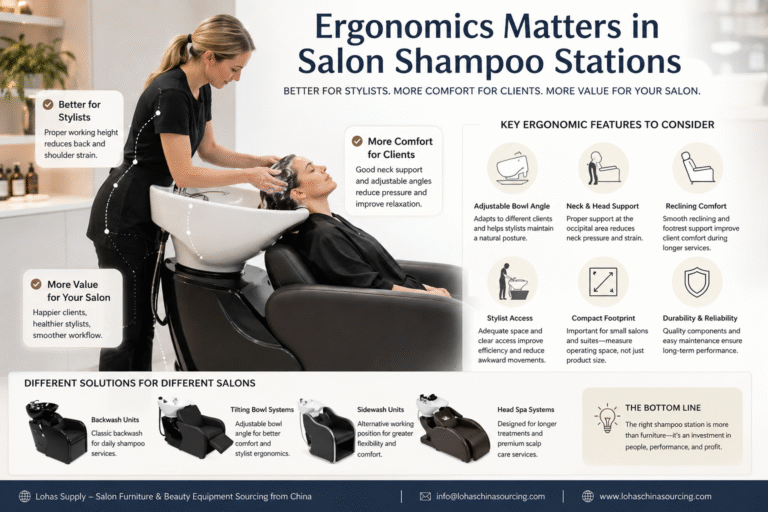
A shampoo station can look perfectly acceptable in a product photo and still become one of the most uncomfortable workstations in a salon.
A recent discussion among salon owners illustrated the problem unusually well.
One salon professional described working with older shampoo units that were too low for her working height. She was experiencing back discomfort, while some clients were also finding it increasingly difficult to recline fully into the bowl. Towels had become an improvised solution for positioning, and an upcoming salon remodel made space efficiency another consideration.
The discussion quickly moved away from colour, upholstery and appearance.
Owners started talking about:
- bowl height;
- client positioning;
- neck support;
- recline angle;
- working from behind the client;
- comfort for shorter and older customers;
- and whether the equipment still works when the salon moves into a smaller space.
For professional salon furniture buyers, this is an important reminder:
shampoo station ergonomics is not simply a comfort feature. It is part of the equipment’s operational performance.
The Shampoo Area Is a Workstation, Not Just Furniture
Salon furniture is often evaluated visually first.
Buyers compare the shape of the chair, upholstery colour, ceramic bowl, footrest and overall styling. Those factors matter, particularly for salons where furniture contributes heavily to interior identity.
But a shampoo unit is also a workstation used repeatedly throughout the day.
Research into musculoskeletal health among hairdressers has consistently identified physical workload as an occupational issue. A scoping review covering 44 studies found that the lower back, neck and shoulders were among the body areas most frequently associated with musculoskeletal complaints among hairdressers.
The researchers identified risk factors including awkward back posture, repetitive movements, forceful upper-extremity activity and prolonged standing.
A separate occupational health study of salon workers in Los Angeles also concluded that ergonomic workstation assessment could be useful in reducing musculoskeletal risks.
This does not mean one shampoo unit will prevent back pain.
It does mean equipment design can either help create a more workable posture or repeatedly force the stylist to compensate for a poor workstation.
Small Height Differences Can Become Large Operational Problems
A shampoo unit does not need to be dramatically wrong to create frustration.
If the bowl sits slightly too low for a stylist, the difference may be compensated for by leaning forward.
Once might not matter.
Repeated across multiple clients every working day, the same small compromise becomes part of the operator’s normal posture.
The reverse problem also exists.
A workstation that suits a taller stylist may become awkward for a shorter stylist if the basin, client head position or access area cannot be adjusted sufficiently.
This is particularly relevant for salon chains.
A unit selected by one owner or tested by one stylist may eventually be used by dozens of employees with very different heights and working habits.
For multi-location projects, therefore, the useful question is not:
“Is this shampoo unit comfortable?”
It is:
“How wide a range of operators and clients can use this workstation comfortably without improvised adjustments?”
Client Ergonomics Matters Just as Much
The stylist is only half of the equation.
Traditional backwash units require the client’s head and neck to align with the basin while the body remains supported by the chair.
If that geometry does not work well for the individual customer, the salon often compensates.
Extra towels appear behind the neck.
The client slides forward or backward.
The stylist repeatedly repositions the head.
Water may become more difficult to control.
What appears to be a minor comfort issue can therefore affect the entire shampoo workflow.
This becomes even more noticeable when salons serve customers with different:
- heights;
- body proportions;
- neck mobility;
- recline preferences;
- and tolerance for longer shampoo or treatment sessions.
The increasing popularity of longer scalp-care and Head Spa treatments makes this particularly relevant. A position that is acceptable for a quick shampoo may feel very different during a much longer treatment.
Why Established Brands Are Paying Attention to Head and Neck Support
Several established salon equipment brands already treat this as a product-design issue rather than an accessory issue.
Takara Belmont’s YUME system, for example, uses a combination of neck and head cushions designed to provide three-point support. The company specifically positions the system around reducing strain on the neck while supporting longer reclining treatments.
Other Takara Belmont shampoo units incorporate features such as tilting basins, gel neck rests and bowl designs intended to improve access and positioning.
HeadBed takes a different approach.
Rather than replacing the shampoo unit, the product adds a small support platform at the basin to support the head around the occipital area instead of relying only on padding under the neck.
Whether a salon chooses an integrated system or an accessory solution, the product logic is similar:
supporting the head properly can be more important than simply making the edge of the bowl softer.
Bowl Adjustment Can Be More Valuable Than Another Electronic Function
Salon equipment manufacturers frequently compete by adding functions.
Electric recline.
Heating.
Massage.
Motorised footrests.
Electronic controls.
These functions can create genuine value in the right commercial setting.
But for a shampoo station, a relatively simple mechanical feature may sometimes have greater daily impact.
A tilting bowl, for example, can help adapt the basin position to different clients rather than forcing every client into exactly the same geometry.
Minerva Beauty’s Avery shampoo system provides a useful example. The unit combines a tilting ceramic bowl and gel neck rest with a reclining footrest, and can be configured for either backwash or sidewash use.
The interesting point is not whether one specific model is better than another.
It is that several seemingly ordinary design details can influence how adaptable the workstation becomes.
Backwash or Sidewash? Flexibility Has Commercial Value
Most contemporary salon furniture discussions focus on backwash systems, where the stylist works behind the client.
But not every salon layout or operator prefers exactly the same working position.
A system capable of supporting different approaches may therefore have value for some markets.
For smaller salons in particular, flexibility can become part of the purchasing decision.
A solo stylist remodeling into a smaller suite has very different spatial requirements from a 20-chair salon.
The equipment has to coexist with:
- stylist circulation;
- plumbing locations;
- storage;
- customer movement;
- and enough clearance to work around the basin.
This is why overall dimensions alone do not tell the whole story.
Footprint Should Be Measured in Use, Not Just on the Specification Sheet
One of the easiest mistakes in salon space planning is to compare only the closed dimensions of equipment.
A reclining shampoo system may look compact on paper.
But once the back reclines or the footrest opens, the operating footprint can become substantially larger.
Minerva’s Avery system, for example, lists a footprint of approximately 25.5 inches wide by 49 inches deep in its standard configuration, but the depth increases significantly when the footrest is extended.
Professional buyers should therefore distinguish between:
- shipping dimensions;
- installed dimensions;
- operating dimensions;
- and the clearance required for the stylist to work around the unit.
This matters particularly for:
- salon suites;
- small independent salons;
- urban locations;
- renovation projects;
- and chains trying to maximise revenue per square metre or square foot.
There Is No Single “Ergonomic Shampoo Unit”
Ergonomic is a frequently used marketing word in salon equipment.
But the term by itself tells buyers very little.
A product can claim to be ergonomic because it has a curved seat or padded neck rest while still being unsuitable for a particular salon.
Professional buyers should instead break ergonomics into specific design questions.
Operator Working Height
Where does the client’s head sit relative to the stylist’s natural working position?
Does the operator need to bend excessively to reach the hairline, nape or underside of the head?
Bowl Position and Tilt
Can the basin angle adapt to different clients?
Is the bowl deep enough to control water while still allowing the stylist access?
Head and Neck Support
Where is the client’s weight actually supported?
Does the customer rely heavily on the neck edge of the bowl, or does the system provide additional support?
Seat and Recline Geometry
Does the chair require every customer to recline to the same degree?
How does the position change when the footrest is used?
Stylist Access
Can the stylist work comfortably from behind or from the side when required?
Are cabinet panels, armrests or structural components blocking useful working positions?
Service Duration
A configuration suitable for a five-minute shampoo may not necessarily be ideal for a 30-minute scalp treatment.
Older Clients Expose Design Weaknesses Faster
One particularly useful signal from salon-owner discussions is the difficulty some clients experience with deep recline positions.
This should not be interpreted as a claim that every older client requires specialised furniture.
But it does highlight an important product-development question:
how tolerant is the equipment of customers who cannot or do not want to adopt the ideal textbook position?
A salon serving customers across a wide age range may benefit from greater positioning flexibility.
For distributors, this can even become a useful form of product segmentation.
Instead of offering ten shampoo units differentiated mainly by upholstery design, a range could include models built around different commercial needs:
- compact units for small salons;
- high-comfort reclining systems;
- premium Head Spa configurations;
- units designed for flexible client positioning;
- and robust commercial backwash systems for high-volume chains.
What Distributors Should Learn from Real Salon Complaints
Salon-owner discussions can be surprisingly valuable product research.
Customers rarely describe problems in engineering language.
They say:
“This is killing my back.”
“My client cannot get comfortable.”
“I need three towels under her neck.”
“I cannot reach properly from behind.”
“This takes up too much space.”
For equipment distributors and product developers, those statements are useful because they describe the consequences of design decisions.
The next step is to translate them into product variables:
- height;
- angle;
- support;
- clearance;
- adjustability;
- footprint;
- and workflow.
This is more valuable than simply asking factories which shampoo unit is their “best seller.”
For Salon Chains, Test the Workstation with Different People
A chain buying dozens of shampoo stations has more at stake than an independent salon buying one.
Before approving a model for rollout, the pilot should ideally involve more than the purchasing manager or salon owner sitting in the chair once.
The equipment should be observed under normal service conditions with:
- different stylists;
- different client heights;
- different service durations;
- and different working positions.
The goal is not to create a laboratory ergonomics study.
It is simply to identify obvious mismatches before they are multiplied across many locations.
A small usability problem in one salon can become a very expensive standardisation problem across 50 branches.
What This Means for Buyers Sourcing from China
Chinese salon furniture manufacturers offer a very wide range of shampoo units, from basic backwash stations to electric reclining systems and Head Spa equipment.
That variety is useful, but product comparison can easily become too visual.
Two shampoo units may use almost the same product photo style while differing in:
- bowl geometry;
- bowl tilt range;
- seat dimensions;
- recline mechanism;
- neck-rest design;
- working height;
- plumbing access;
- operating footprint;
- and internal construction.
For repeat buyers, these details deserve more attention than whether one model is US$30 cheaper.
Lohas Supply supplies salon furniture and beauty equipment from China and can help distributors, salon groups and professional buyers compare shampoo-unit configurations, clarify specifications and coordinate production and quality control for repeat orders.
The Bigger Opportunity: Sell Better Workstations, Not Just Better-Looking Furniture
Salon furniture will always be a design-driven category.
A beautiful interior matters.
But the shampoo station is one place where appearance and daily physical use collide.
The equipment needs to work for the customer sitting in it and the professional standing behind it.
As salons add longer scalp-care services, serve increasingly varied customer groups and operate in smaller or more carefully planned spaces, this becomes harder to ignore.
For professional buyers, the opportunity is not necessarily to find the shampoo unit with the most features.
It is to identify the configuration that creates the fewest compromises in real salon use.
Good ergonomics often becomes visible only after the product has been used all day.
By then, changing the specification is much more expensive.
Sources & Product References
NIOSH / CDC — Occupational Health Survey of Hair Salon Workers
Takara Belmont USA — Spa & Shampoo Equipment
Takara Belmont — YUME Product Brochure
Minerva Beauty — Avery Shampoo System
HeadBed USA — Head and Neck Support Design
Looking to Upgrade Your Shampoo & Backwash Range?
Discuss Your Product Requirements
Prefer email?