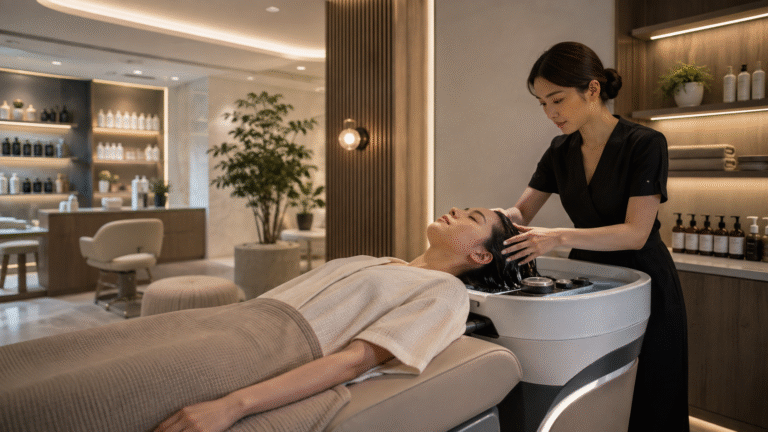
What Buyers Need to Know
- Scalp care is showing measurable growth in the professional salon market, rather than relying only on social-media visibility.
- Head spa is appearing in several business formats: specialist studios, traditional hair salons, luxury wellness spaces and multi-service beauty businesses.
- Those businesses do not necessarily need the same equipment.
- For distributors, carrying more models is not automatically the best strategy. Matching equipment to the target salon format may be more important than maximizing SKU count.
- For salon chains, a successful pilot should test not only customer demand, but also installation, staff workflow, cleaning, maintenance and service time.
Scalp Care Is Moving Beyond a Niche Add-On
One of the strongest signals comes from the professional hair-care market itself.
According to Kline, scalp treatment services in U.S. salons grew 9% during the first three quarters of 2025 compared with the same period in 2024. Salon retail products positioned around scalp care also grew 6% over the same period. Kline describes scalp care as moving beyond a niche add-on toward a premium category combining science, beauty and wellness.
This is important because it suggests two different sources of demand are developing at the same time.
The first is the service opportunity: salons can sell scalp-focused treatments as bookable experiences.
The second is the retail opportunity: scalp serums, cleansers, treatments and related products can extend the service into an at-home routine.
For professional buyers, this makes head spa more interesting than a single piece of trending equipment. It has the potential to sit inside a wider service-and-retail ecosystem.
The Business Model Is Also Changing
Another useful signal appeared in Charlotte, North Carolina in August 2026.
Kenna Kunijo, an established hair salon that has expanded from a small salon into a much larger location, announced the addition of a Japanese head spa service as part of its evolution toward a broader beauty-and-wellness destination.
The salon already allows customers to combine different services within one location, including hair, facial and aesthetic treatments. Head spa is being added to that ecosystem rather than launched as a completely separate business.
This is only one salon and should not be treated as proof that every salon will follow the same model. However, it illustrates an important direction for equipment buyers:
Head spa demand may increasingly come from existing salons adding a new revenue-generating service, not only from dedicated head spa studios opening from scratch.
That changes the equipment question considerably.
One Trend, Several Very Different Equipment Buyers
When suppliers use the term “head spa market,” they can easily treat all potential customers as one group. In practice, at least four different commercial formats may need to be considered.
1. Dedicated Head Spa Studios
A specialist studio can design its entire space around the treatment.
It may have more flexibility to create private treatment rooms, install dedicated plumbing and choose equipment with more functions because the head spa experience is the core service rather than an add-on.
For this buyer, the treatment bed can become part of the customer experience itself.
2. Existing Hair Salons Adding Head Spa
An established salon faces a different problem.
It already has shampoo stations, styling chairs, plumbing, staff routines and a fixed floor plan. Adding head spa may therefore require fitting a new service into an existing operating system.
Questions about footprint, installation, service time and compatibility with the existing shampoo area may become more important than simply choosing the equipment with the longest feature list.
3. Multi-Service Beauty and Wellness Businesses
Some operators are increasingly combining hair, scalp care, facial treatments, massage or other beauty services in one location.
For these businesses, equipment utilization matters.
A treatment station that can support more than one commercially useful service may be attractive, but multifunctionality also needs to be evaluated carefully. More functions can mean more components, more cleaning requirements and potentially more complicated maintenance.
The right question is therefore not:
“How many functions does this bed have?”
It is:
“Which functions will this business actually use often enough to justify the additional complexity?”
4. Salon Chains
For a multi-location operator, the problem changes again.
A product that works successfully in one flagship location may not automatically be suitable for rollout across 20 or 50 branches.
Chains need to think about repeatability:
- Can the same configuration be supplied consistently?
- Will installation conditions vary between locations?
- Can staff be trained on a standardized service workflow?
- Which replacement parts are available for the specific model?
- How difficult will maintenance become across multiple locations?
- Can the supplier maintain the model long enough to support future expansion and replacement needs?
This is where product selection becomes a supply-chain decision rather than simply an interior-design decision.
The Equipment Market May Fragment Rather Than Converge
When a category becomes popular, suppliers often respond by adding more functions and producing increasingly similar-looking versions of the same product.
But a growing market does not necessarily converge around one winning head spa bed.
The opposite may happen.
Different salon formats can create demand for several equipment architectures:
- full-size dedicated head spa beds;
- more compact units for existing salons;
- systems that connect to permanent water supply and drainage;
- portable or less infrastructure-intensive configurations;
- multi-service treatment beds;
- premium equipment designed around a private wellness experience;
- simpler commercial models focused on easier operation and maintenance.
The exact configuration available varies by manufacturer and model. Buyers therefore need to compare not only appearance and headline functions, but also how the equipment fits the target customer’s actual business environment.
For professional buyers evaluating head spa equipment from China, the sourcing challenge is increasingly not simply finding a product. It is matching the equipment configuration to the salon format, installation environment, operating model and after-sales requirements of the target market.
Lohas Supply supports international buyers in comparing Chinese suppliers, clarifying product configurations and coordinating sourcing before a model is selected for wider distribution or rollout.
For Distributors: More SKUs Are Not Necessarily Better
The rapid appearance of new head spa equipment can create pressure for distributors to expand their range quickly.
But every additional model creates another set of responsibilities.
The distributor may eventually need to understand:
- which customer segment the model is intended for;
- what installation conditions it requires;
- which parts may need replacement;
- what documentation and support the manufacturer provides;
- how the equipment should be packed for international transport;
- whether the manufacturer can continue supplying the model and its compatible parts.
A visually impressive new model may generate inquiries, but a difficult-to-support product can create after-sales costs long after the original margin has been earned.
For that reason, the current head spa trend may reward distributors that build a clear product architecture rather than simply a large catalog.
For example, a distributor might eventually decide that its market requires only three clearly differentiated options:
- a practical entry-level model for salons adding their first head spa service;
- a higher-spec model for dedicated treatment rooms;
- a premium or multi-service model for wellness-focused operators.
The appropriate range will depend on the distributor’s market, customer type and service capability. The important point is that product segmentation should follow commercial use cases rather than supplier catalogs.
For Salon Chains: Test the Operating Model, Not Just the Bed
A pilot head spa service can answer questions that a product specification sheet cannot.
Before a wider rollout, a chain may want to observe:
- actual treatment duration;
- room turnover between customers;
- cleaning and sanitation workflow;
- staff movement around the equipment;
- customer comfort;
- water and drainage performance under real use;
- how often different functions are actually used;
- minor maintenance issues;
- whether the service generates enough demand to justify the space it occupies.
This is especially important for equipment with water circulation, heating, electrical controls, moving components or other integrated