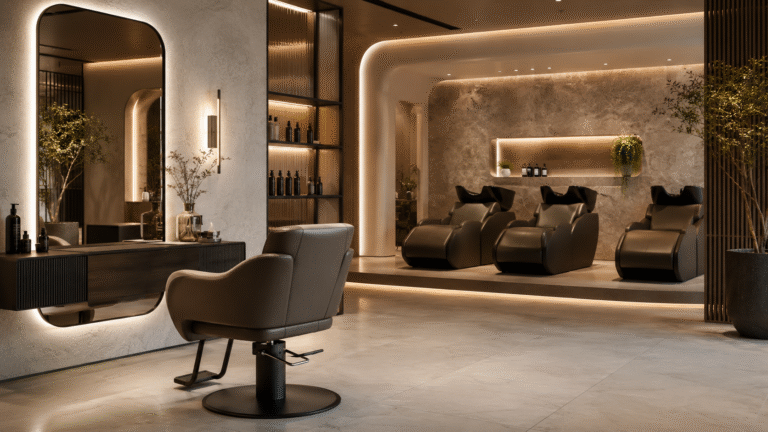
But looking at established salon furniture brands in 2026, it is increasingly clear that the premium end of the market is no longer competing only on the physical product.
Takara Belmont, Maletti and Gamma & Bross approach the market differently, but their current product positioning points toward a similar shift:
premium salon furniture is increasingly being sold as part of a service experience, a working environment and a broader salon business concept.
For salon furniture distributors, brands and multi-location salon groups, this matters more than simply following the latest chair shape or upholstery colour.
The more useful question is:
What are established brands adding around the furniture itself — and what does that tell buyers about where the market may be heading?
What Professional Buyers Should Notice
- Premium positioning is moving beyond design alone.
- Equipment is increasingly connected to services, wellness and customer experience.
- Operator ergonomics remains an important part of professional product value.
- Strong brands sell a coherent product concept rather than an unrelated collection of individual SKUs.
- For distributors developing their own range, copying an appearance is much less useful than understanding why a product has commercial value.
Takara Belmont: When Equipment Becomes a Service Platform
Takara Belmont provides one of the clearest examples of how professional salon furniture can extend beyond the physical product.
Its YUME Head Spa ecosystem does not stop at selling a shampoo or treatment unit.
The company also operates a dedicated YUME Head Spa education program covering treatment techniques, equipment use, consultation, service development and commercial considerations.
The training program discusses expanding service menus, promoting retail sales, improving the client experience and even planning pricing and packaging strategies for Head Spa services.
For a professional buyer, that is an important distinction.
The equipment is being positioned not simply as:
“Here is a better shampoo unit.”
It is closer to:
“Here is an infrastructure platform around which the salon can build a higher-value service.”
This changes how the product can be evaluated.
A salon chain considering a premium shampoo or Head Spa system may therefore look beyond:
- the bowl;
- the upholstery;
- the motor;
- the reclining mechanism;
- the exterior design.
It may also consider:
- what new service the equipment enables;
- how easily staff can be trained;
- how the service fits existing workflow;
- whether it creates additional retail opportunities;
- how consistently the concept can be repeated across multiple locations.
This is a much more sophisticated value proposition than simply competing on furniture specifications.
The Lesson for Distributors: Ask What Revenue the Product Supports
For salon furniture distributors, this creates a useful way to evaluate emerging categories.
Instead of asking only:
“Will customers like this product?”
the distributor can also ask:
“What can the salon sell because it owns this product?”
A visually attractive chair may improve the interior.
A new treatment system may create an entirely new appointment category.
A better shampoo configuration may improve customer comfort or allow the salon to reposition an existing service.
These are very different commercial roles.
This is particularly relevant as Head Spa equipment becomes more visible across international salon markets. A distributor deciding whether to add Head Spa furniture should therefore look beyond the novelty of the equipment and understand how salons in its target market are actually monetising the service.
Maletti: The Salon Is Becoming an Experience Environment
Maletti offers another useful signal.
At Cosmoprof Worldwide Bologna 2026, the Italian salon furniture company presented its stand around the idea of an immersive, multisensory salon experience.
The concept deliberately moved beyond the traditional idea of salon furniture as a collection of chairs, mirrors and wash units.
Lighting, materials, temperature, sound, wellness and treatment rituals were presented as parts of one environment.
Head Spa was a central element of this direction.
Maletti described the treatment not simply as a technical service but as something more immersive, sensory and personalised. Its Heaven Soft wash unit was positioned around both client comfort and operator ergonomics within this wider treatment concept.
The company has also expanded further into Head Spa technology through systems such as Spa Garçon Éclat, which integrates several scalp-care functions and structured treatment protocols.
The broader commercial message is particularly interesting:
salon furniture is being positioned as infrastructure for an experience, rather than decoration around a service.
Why This Matters for Salon Furniture Buyers
This does not mean every salon needs an immersive wellness room.
Nor does it mean every distributor should immediately add complex treatment technology to its catalog.
But it does suggest that professional buyers should pay more attention to the relationship between furniture and service design.
For example, a shampoo area may traditionally have been treated as a necessary operational zone between cutting or colouring services.
Under a Head Spa or wellness-oriented model, the same area may become part of the revenue-generating experience itself.
That can change the importance of:
- reclining comfort;
- privacy;
- lighting;
- noise;
- operator access;
- treatment duration;
- storage;
- water management;
- maintenance access;
- visual integration with the rest of the salon.
These are not simply aesthetic decisions.
They influence how the salon operates and how the customer perceives the service.
Gamma & Bross: Design Still Matters — But the Language Is Changing
Gamma & Bross provides a slightly different perspective.
Its current salon chair materials highlight several 2026 design directions, including ergonomic minimalism, softer forms and increasing attention to sustainable materials.
These trends are worth watching because they reflect a broader movement away from some of the heavy, highly decorative salon furniture styles that historically defined the category.
In many contemporary interiors, premium no longer necessarily means visually complicated.
It can mean:
- cleaner forms;
- better proportions;
- softer geometry;
- more restrained materials;
- better ergonomic integration;
- a stronger relationship between furniture and architectural space.
Gamma & Bross also operates different product and brand positions within its wider furniture portfolio, ranging from higher-end collections to more accessible design lines and wellness-oriented products.
That is another useful lesson for distributors.
A Good Product Range Needs Segmentation
Many salon furniture distributors make the mistake of building a catalog around individual products rather than customer segments.
The result may be dozens of chairs that look different but do not have clearly different commercial roles.
A more structured range might instead contain:
Commercial Core
Reliable, repeatable products intended for everyday salons, multi-location operators or dealers that need consistent volume.
Design Upgrade
Products with stronger materials, shapes or finishing for customers willing to pay more for interior differentiation.
Premium Statement Product
A distinctive chair, shampoo unit or treatment system designed to become part of the salon’s visual identity.
Service-Enabling Equipment
Equipment such as Head Spa systems or multifunction treatment furniture that allows the salon to introduce or upgrade a specific service.
This type of segmentation can be more commercially useful than simply offering 50 different designs at similar price points.
Premium Is Becoming Less About Decoration
Looking across these brands, another pattern emerges.
Premium salon furniture does not appear to be moving in only one visual direction.
Some salons remain glamorous and highly decorative.
Others favour softer minimalism, residential influences or wellness-inspired interiors.
The common factor is increasingly not a particular colour or material.
It is whether the furniture supports a clear salon identity and a higher-value customer experience.
This distinction matters for Chinese salon furniture suppliers and overseas distributors.
It is relatively easy for the supply side to react to a visual trend.
If beige chairs become popular, factories can produce more beige chairs.
If rounded shapes become popular, rounded chairs can appear quickly.
If Head Spa becomes popular, dozens of new Head Spa beds can enter supplier catalogs within a short period.
But reproducing a visible trend is not the same as understanding the commercial reason behind it.
When Chinese Suppliers Follow a Trend, Buyers Need to Look Deeper
China’s salon furniture supply base is highly responsive.
That responsiveness is one of its strengths.
When a new category gains attention, factories can develop variations quickly and buyers may suddenly have dozens of models to compare.
But this creates another challenge for professional importers.
Products that appear similar in photographs may have very different levels of maturity.
One model may have been refined through repeated commercial orders.
Another may have been launched recently because suppliers saw competitors selling something similar.
This distinction becomes especially important for products involving:
- hydraulic or electric movement;
- water circulation;
- heating;
- electronic controls;
- multiple treatment functions;
- specialised replacement parts.
For distributors, the question should therefore not simply be:
“Can I find a similar-looking product at a lower price?”
A better question is:
“Can this supplier support the product position I want to build in my market?”
What Should Buyers Benchmark from Premium Brands?
Premium brands can be useful benchmarks, but not because buyers should copy them.
Designs, trademarks and intellectual property should be respected.
The more useful exercise is to study the business logic behind the products.
Professional buyers can ask:
- What customer segment is this product designed for?
- What problem does it solve better than a standard alternative?
- Does it create a new service opportunity?
- Does it improve operator ergonomics?
- Does the design contribute meaningfully to the salon environment?
- Is the premium based on materials, engineering, brand, service support or all four?
- How does the company build a coherent range around different customer types?
- What happens after the equipment is sold?
These questions are much more valuable than asking a Chinese factory to reproduce the appearance of a premium European or Japanese model.
For Private-Label and Distribution Buyers, Positioning Comes Before Sourcing
This is particularly important for distributors and brands developing their own salon furniture collections.
Before asking suppliers for dozens of models, the buyer should be able to define the role of the range.
For example:
Is the target customer a value-focused independent salon?
A design-conscious boutique salon?
A high-volume salon chain?
A premium wellness concept?
A distributor that needs reliable products with easy replacement parts?
These buyers may all purchase salon furniture, but they should not necessarily receive the same product specification.
For buyers building a salon furniture range from China, Lohas Supply focuses on matching product positioning with suitable manufacturing partners, specifications and commercial requirements rather than simply presenting a large catalog of unrelated models.
This is especially useful when several Chinese factories offer products that look similar online but differ in construction, components, customisation capability or consistency across repeat orders.
What This Means for Salon Chains
There is also an important lesson for multi-location salon operators.
A flagship salon may justify statement furniture and experimental treatment equipment.
A network of 30 branches has different requirements.
Once equipment is rolled out across multiple locations, factors such as consistency, maintenance, spare parts and model continuity become much more important.
A salon chain can still use premium design, but the product needs to work as part of a repeatable operating system.
This creates a different definition of premium:
not simply the most expensive product, but the product that consistently supports the intended customer experience across every location.
Three Brands, Three Useful Signals
Takara Belmont, Maletti and Gamma & Bross should not be treated as identical companies or direct substitutes.
Each has its own design language, market history and product strategy.
But viewed together, they highlight several signals worth watching.
1. Furniture Is Moving Closer to Service Strategy
Head Spa demonstrates particularly clearly how equipment can become part of the salon’s revenue model rather than simply a physical necessity.
2. Experience Is Becoming Part of Product Value
Comfort, sensory environment, wellness and interior integration increasingly influence how premium salon equipment is positioned.
3. Ergonomics Still Matters
Even as design becomes more sophisticated, professional equipment ultimately has to work for the operator every day.
4. Product Architecture Matters
Strong brands do not simply offer hundreds of unrelated SKUs. They create collections, price positions and product roles that help buyers understand where each product belongs.
5. The Supply Opportunity Is Not Simply to Copy Premium Products
For Chinese suppliers and international buyers, the more valuable opportunity is to identify which premium features create real commercial value and develop specifications appropriate for the target market.
The Bigger Question for 2026
Salon furniture is still a physical product business.
Durability, price, materials, packaging and manufacturing quality remain fundamental.
But the premium end of the market increasingly shows that the furniture itself is only one layer of value.
The strongest products sit inside something larger:
- a service concept;
- a salon identity;
- a customer experience;
- an operating workflow;
- a repeatable business model.
For distributors, brands and salon groups sourcing professional salon furniture, this may be the most useful lesson to take from established premium brands.
Do not start by asking which product looks premium.
Start by deciding what role the product needs to play in the customer’s business.
Sources & Brand References
Takara Belmont USA — YUME Head Spa Training Program
Takara Belmont USA — YUME Head Spa Education
Maletti — Cosmoprof 2026: Redefining the Salon Experience
Maletti — Spa Garçon Éclat and the Evolution of Head Spa
Gamma & Bross — Salon Styling Chairs and 2026 Design Trends
Looking to Build or Expand Your Salon Furniture Range?
Discuss Your Product Requirements
Prefer email?